
Ch. 6 - Applications of Integration
Briggs - Calculus: Early Transcendentals 3rd Edition
Briggs3rd EditionCalculus: Early TranscendentalsISBN: 9780136847243Not the one you use?Change textbook
Chapter 6, Problem 6.7.57c

Explain why or why not Determine whether the following statements are true and give an explanation or counterexample.
c. The work required to lift a 10-kg object vertically 10 m is the same as the work required to lift a 20-kg object vertically 5 m.

Verified step by step guidance
1
Recall the formula for work done against gravity when lifting an object vertically: \(W = m \cdot g \cdot h\), where \(m\) is the mass of the object, \(g\) is the acceleration due to gravity (approximately \(9.8\, m/s^2\)), and \(h\) is the height the object is lifted.
Calculate the work done to lift the 10-kg object 10 meters: \(W_1 = 10 \cdot g \cdot 10\).
Calculate the work done to lift the 20-kg object 5 meters: \(W_2 = 20 \cdot g \cdot 5\).
Compare \(W_1\) and \(W_2\) by simplifying both expressions to see if they are equal or not.
Conclude whether the statement is true or false based on the comparison, and explain that work depends on both mass and height, so equal work means the product \(m \cdot h\) must be the same.

Verified video answer for a similar problem:

This video solution was recommended by our tutors as helpful for the problem above.
Video duration:
2m
Was this helpful?

Key Concepts

Here are the essential concepts you must grasp in order to answer the question correctly.

Work Done by a Force

Work is defined as the product of the force applied to an object and the displacement in the direction of the force. Mathematically, work = force × distance × cos(θ). For lifting vertically, the force equals the weight of the object, and displacement is the vertical height moved.
Recommended video:
05:40
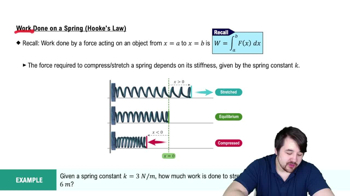
Work Done On A Spring (Hooke's Law)

Weight and Gravitational Force

Weight is the gravitational force acting on an object and is calculated as mass times gravitational acceleration (W = mg). Different masses result in different weights, which directly affect the amount of work needed to lift the object.
Recommended video:
09:32
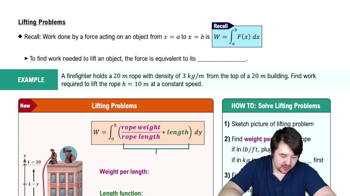
Lifting Problems

Comparing Work for Different Masses and Distances

To compare work done lifting different masses over different heights, multiply each mass by gravitational acceleration and the height lifted. If the products are equal, the work done is the same; otherwise, it differs. This helps determine if lifting a heavier object a shorter distance equals lifting a lighter object a longer distance.
Recommended video:
09:32
Lifting Problems
Related Practice
Textbook Question

A nonlinear spring Hooke’s law is applicable to idealized (linear) springs that are not stretched or compressed too far from their equilibrium positions. Consider a nonlinear spring whose restoring force is given by F(x) = 16x−0.1x³, for |x|≤7. 

c. How much work is done in compressing the spring from its equilibrium position (x=0) to x=−2?

1
views
Textbook Question

Bike race Theo and Sasha start at the same place on a straight road, riding bikes with the following velocities (measured in mi/hr). Assume t is measured in hours.

Theo: vT(t)=10, for t≥0

Sasha: vS(t)=15t, for 0≤t≤1, and vS(t)=15, for t>1


c. If the riders ride for 2 hr, who rides farther? Interpret your answer geometrically using the graphs of part (a). 

1
views
Textbook Question

Determine whether the following statements are true and give an explanation or counterexample. 


c. Let f(x)=12x^2. The area of the surface generated when the graph of f on [−4, 4] is revolved about the x-axis is twice the area of the surface generated when the graph of f on [0, 4] is revolved about the x-axis. 

Textbook Question

Let R be the region bounded by the curve y=√cos x and the x-axis on [0, π/2]. A solid of revolution is obtained by revolving R about the x-axis (see figures). 


c. Write an integral for the volume of the solid.

1
views
Textbook Question

Day hike The velocity (in mi/hr) of a hiker walking along a straight trail is given by v(t) = 3 sin² πt/2, for 0≤t≤4. Assume s(0)=0 and t is measured in hours. 


c. What is the hiker’s position at t=3?

1
views
Textbook Question

Flying into a headwind The velocity (in mi/hr) of an airplane flying into a headwind is given by v(t) = 30(16−t²), for 0≤t≤3. Assume s(0)=0 and t is measured in hours.


c. How far has the airplane traveled at the instant its velocity reaches 400 mi/hr?