

Ch. 6 - Applications of Integration
Briggs - Calculus: Early Transcendentals 3rd Edition
Briggs3rd EditionCalculus: Early TranscendentalsISBN: 9780136847243Not the one you use?Change textbook
Chapter 6, Problem 6.3.5c

Let R be the region bounded by the curve y=√cos x and the x-axis on [0, π/2]. A solid of revolution is obtained by revolving R about the x-axis (see figures). 


c. Write an integral for the volume of the solid.

Verified step by step guidance
1
Identify the region R bounded by the curve \(y = \sqrt{\cos x}\) and the x-axis on the interval \([0, \frac{\pi}{2}]\). This means the region lies between \(y = 0\) and \(y = \sqrt{\cos x}\) for \(x\) in \([0, \frac{\pi}{2}]\).
Since the solid is formed by revolving the region R about the x-axis, use the disk method to find the volume. The volume of a solid of revolution generated by revolving a curve \(y = f(x)\) about the x-axis from \(x = a\) to \(x = b\) is given by the integral \(V = \pi \int_a^b [f(x)]^2 \, dx\).
In this problem, the function is \(f(x) = \sqrt{\cos x}\), so the radius of each disk is \(\sqrt{\cos x}\). Squaring this radius gives the area of the cross-sectional disk as \([\sqrt{\cos x}]^2 = \cos x\).
Set up the integral for the volume using the limits of integration \(0\) to \(\frac{\pi}{2}\):
\[V = \pi \int_0^{\frac{\pi}{2}} \cos x \, dx.\]

Verified video answer for a similar problem:

This video solution was recommended by our tutors as helpful for the problem above.
Video duration:
2m
Was this helpful?

Key Concepts

Here are the essential concepts you must grasp in order to answer the question correctly.

Region Bounded by a Curve and the x-axis

Understanding the region bounded by the curve y = √cos x and the x-axis on [0, π/2] is essential. This involves identifying the area under the curve from x = 0 to x = π/2, which forms the cross-sectional shape to be revolved around the x-axis.
Recommended video:
05:23
Finding Area Between Curves on a Given Interval

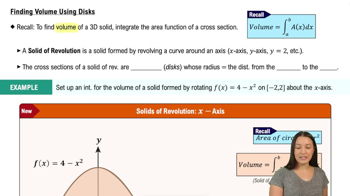
Volume of a Solid of Revolution Using the Disk Method

The disk method calculates the volume of a solid formed by revolving a region around the x-axis. The volume is found by integrating π times the square of the radius function (here, y = √cos x) with respect to x over the given interval.
Recommended video:
04:48
Finding Volume Using Disks

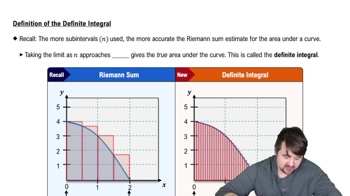
Setting up Definite Integrals for Volume

Writing the integral requires expressing the volume as an integral with proper limits and integrand. For this problem, the integral is from 0 to π/2 of π times (√cos x)² dx, simplifying to π∫₀^{π/2} cos x dx, which represents the volume of the solid.
Recommended video:
05:43
Definition of the Definite Integral
Related Practice
Textbook Question

A nonlinear spring Hooke’s law is applicable to idealized (linear) springs that are not stretched or compressed too far from their equilibrium positions. Consider a nonlinear spring whose restoring force is given by F(x) = 16x−0.1x³, for |x|≤7. 

c. How much work is done in compressing the spring from its equilibrium position (x=0) to x=−2?

1
views
Textbook Question

Bike race Theo and Sasha start at the same place on a straight road, riding bikes with the following velocities (measured in mi/hr). Assume t is measured in hours.

Theo: vT(t)=10, for t≥0

Sasha: vS(t)=15t, for 0≤t≤1, and vS(t)=15, for t>1


c. If the riders ride for 2 hr, who rides farther? Interpret your answer geometrically using the graphs of part (a). 

1
views
Textbook Question

Let R be the region in the first quadrant bounded above by the curve y=2−x² and bounded below by the line y=x. Suppose the shell method is used to determine the volume of the solid generated by revolving R about the y-axis.

c. Write an integral for the volume of the solid using the shell method.

Textbook Question

Filling a tank A 2000-liter cistern is empty when water begins flowing into it (at t=0 at a rate (in L/min) given by Q′(t) = 3√t, where t is measured in minutes.


c. When will the tank be full?

Textbook Question

Explain why or why not Determine whether the following statements are true and give an explanation or counterexample.

c. The work required to lift a 10-kg object vertically 10 m is the same as the work required to lift a 20-kg object vertically 5 m.

Textbook Question

Flow rates in the Spokane River The daily discharge of the Spokane River as it flows through Spokane, Washington, in April and June is modeled by the functions

r1(t) = 0.25t²+37.46t+722.47 (April) and

r2(t) = 0.90t²−69.06t+2053.12 (June), where the discharge is measured in millions of cubic feet per day, and t=0 corresponds to the beginning of the first day of the month (see figure).

c. The Spokane River flows out of Lake Coeur d’Alene, which contains approximately 0.67mi³ of water. Determine the percentage of Lake Coeur d’Alene’s volume that flows through Spokane in April and June.