
Ch. 6 - Applications of Integration
Briggs - Calculus: Early Transcendentals 3rd Edition
Briggs3rd EditionCalculus: Early TranscendentalsISBN: 9780136847243Not the one you use?Change textbook
Chapter 6, Problem 6.7.59c

A nonlinear spring Hooke’s law is applicable to idealized (linear) springs that are not stretched or compressed too far from their equilibrium positions. Consider a nonlinear spring whose restoring force is given by F(x) = 16x−0.1x³, for |x|≤7. 
c. How much work is done in compressing the spring from its equilibrium position (x=0) to x=−2?

Verified step by step guidance
1
Recall that the work done by a variable force \( F(x) \) when moving an object from position \( a \) to \( b \) is given by the integral \( W = \int_a^b F(x) \, dx \).
Identify the force function given: \( F(x) = 16x - 0.1x^3 \), and the limits of compression from \( x=0 \) to \( x=-2 \).
Set up the integral for the work done in compressing the spring: \( W = \int_0^{-2} (16x - 0.1x^3) \, dx \).
Since the upper limit is less than the lower limit, consider reversing the limits and changing the sign of the integral: \( W = - \int_{-2}^0 (16x - 0.1x^3) \, dx \).
Evaluate the integral by finding the antiderivative of \( 16x - 0.1x^3 \), then substitute the limits \( -2 \) and \( 0 \) to find the work done.

Verified video answer for a similar problem:

This video solution was recommended by our tutors as helpful for the problem above.
Video duration:
3m
Was this helpful?

Key Concepts

Here are the essential concepts you must grasp in order to answer the question correctly.

Work Done by a Variable Force

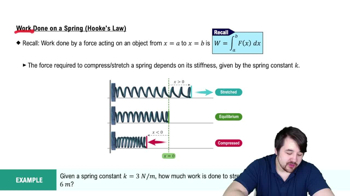
Work done by a force that varies with position is calculated by integrating the force function over the displacement interval. For a spring, this means integrating the restoring force from the initial to the final position to find the total work done in compressing or stretching it.
Recommended video:
05:40
Work Done On A Spring (Hooke's Law)

Nonlinear Spring Force

Unlike Hooke’s law for linear springs (F = -kx), a nonlinear spring has a restoring force that depends on higher powers of displacement, such as F(x) = 16x - 0.1x³. This means the force changes in a more complex way as the spring is compressed or stretched, affecting the work calculation.
Recommended video:
05:40
Work Done On A Spring (Hooke's Law)

Limits of Integration and Sign Conventions

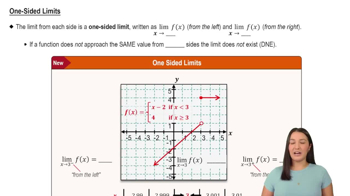
When calculating work done from equilibrium to a compressed position, it is important to set the correct limits of integration (from 0 to -2) and consider the direction of force and displacement. The sign of the force and displacement affects whether the work is positive or negative.
Recommended video:
05:50
One-Sided Limits
Related Practice
Textbook Question

Bike race Theo and Sasha start at the same place on a straight road, riding bikes with the following velocities (measured in mi/hr). Assume t is measured in hours.

Theo: vT(t)=10, for t≥0

Sasha: vS(t)=15t, for 0≤t≤1, and vS(t)=15, for t>1


c. If the riders ride for 2 hr, who rides farther? Interpret your answer geometrically using the graphs of part (a). 

1
views
Textbook Question

Determine whether the following statements are true and give an explanation or counterexample. 


c. Let f(x)=12x^2. The area of the surface generated when the graph of f on [−4, 4] is revolved about the x-axis is twice the area of the surface generated when the graph of f on [0, 4] is revolved about the x-axis. 

Textbook Question

Let R be the region in the first quadrant bounded above by the curve y=2−x² and bounded below by the line y=x. Suppose the shell method is used to determine the volume of the solid generated by revolving R about the y-axis.

c. Write an integral for the volume of the solid using the shell method.

Textbook Question

Filling a tank A 2000-liter cistern is empty when water begins flowing into it (at t=0 at a rate (in L/min) given by Q′(t) = 3√t, where t is measured in minutes.


c. When will the tank be full?

Textbook Question

Let R be the region bounded by the curve y=√cos x and the x-axis on [0, π/2]. A solid of revolution is obtained by revolving R about the x-axis (see figures). 


c. Write an integral for the volume of the solid.

1
views
Textbook Question

Explain why or why not Determine whether the following statements are true and give an explanation or counterexample.

c. The work required to lift a 10-kg object vertically 10 m is the same as the work required to lift a 20-kg object vertically 5 m.