
Ch. 6 - Applications of Integration
Briggs - Calculus: Early Transcendentals 3rd Edition
Briggs3rd EditionCalculus: Early TranscendentalsISBN: 9780136847243Not the one you use?Change textbook
Chapter 6, Problem 6.6.23c

Determine whether the following statements are true and give an explanation or counterexample. 


c. Let f(x)=12x^2. The area of the surface generated when the graph of f on [−4, 4] is revolved about the x-axis is twice the area of the surface generated when the graph of f on [0, 4] is revolved about the x-axis. 

Verified step by step guidance
1
Recall the formula for the surface area generated by revolving a curve \(y = f(x)\) about the x-axis over the interval \([a, b]\): \[S = \int_a^b 2\pi f(x) \sqrt{1 + (f'(x))^2} \, dx\]
Identify the function and its derivative: Given \(f(x) = 12x^2\), then \[f'(x) = 24x\]
Set up the surface area integrals for both intervals: For \([-4, 4]\): \[S_1 = \int_{-4}^4 2\pi (12x^2) \sqrt{1 + (24x)^2} \, dx\] For \([0, 4]\): \[S_2 = \int_0^4 2\pi (12x^2) \sqrt{1 + (24x)^2} \, dx\]
Analyze the integrand's symmetry: Since \(f(x) = 12x^2\) is an even function and \(f'(x) = 24x\) is an odd function, the term inside the square root, \(1 + (f'(x))^2 = 1 + (24x)^2\), is even. The product \(f(x) \sqrt{1 + (f'(x))^2}\) is therefore even because it is the product of an even function and an even function.
Use the property of even functions in integrals: For an even function \(g(x)\), \[\int_{-a}^a g(x) \, dx = 2 \int_0^a g(x) \, dx\] Therefore, \[S_1 = 2 S_2\] This shows that the surface area generated on \([-4,4]\) is twice the surface area generated on \([0,4]\), confirming the statement.

Verified video answer for a similar problem:

This video solution was recommended by our tutors as helpful for the problem above.
Video duration:
5m
Was this helpful?

Key Concepts

Here are the essential concepts you must grasp in order to answer the question correctly.

Surface Area of Revolution

The surface area generated by revolving a curve y = f(x) about the x-axis over an interval [a, b] is found using the formula S = ∫ from a to b 2π f(x) √(1 + (f'(x))^2) dx. This integral accounts for the circumference of circular slices and the curve's slope, providing the total surface area.
Recommended video:
09:07
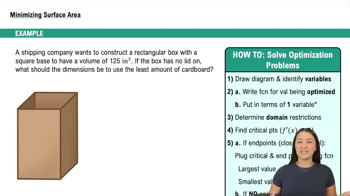
Example 1: Minimizing Surface Area

Symmetry of Functions and Intervals

When a function is even (f(-x) = f(x)) and the interval is symmetric about zero, properties of symmetry can simplify calculations. For surface areas, symmetry does not always imply the surface area over [-a, a] is twice that over [0, a], because the integrand may not be an even function.
Recommended video:
06:21
Properties of Functions

Derivative and Its Role in Surface Area

The derivative f'(x) measures the slope of the function and affects the surface area integral through the term √(1 + (f'(x))^2). This term adjusts the length element to account for the curve's steepness, influencing the total surface area generated by revolution.
Recommended video:
09:07
Example 1: Minimizing Surface Area
Related Practice
Textbook Question

A nonlinear spring Hooke’s law is applicable to idealized (linear) springs that are not stretched or compressed too far from their equilibrium positions. Consider a nonlinear spring whose restoring force is given by F(x) = 16x−0.1x³, for |x|≤7. 

c. How much work is done in compressing the spring from its equilibrium position (x=0) to x=−2?

1
views
Textbook Question

Bike race Theo and Sasha start at the same place on a straight road, riding bikes with the following velocities (measured in mi/hr). Assume t is measured in hours.

Theo: vT(t)=10, for t≥0

Sasha: vS(t)=15t, for 0≤t≤1, and vS(t)=15, for t>1


c. If the riders ride for 2 hr, who rides farther? Interpret your answer geometrically using the graphs of part (a). 

1
views
Textbook Question

Explain why or why not Determine whether the following statements are true and give an explanation or counterexample.

c. The work required to lift a 10-kg object vertically 10 m is the same as the work required to lift a 20-kg object vertically 5 m.

Textbook Question

Determine whether the following statements are true and give an explanation or counterexample.


c. ∫₀¹(x−x^2) dx=∫₀¹(√y−y) dy

2
views
Textbook Question

Day hike The velocity (in mi/hr) of a hiker walking along a straight trail is given by v(t) = 3 sin² πt/2, for 0≤t≤4. Assume s(0)=0 and t is measured in hours. 


c. What is the hiker’s position at t=3?

1
views
Textbook Question

Flying into a headwind The velocity (in mi/hr) of an airplane flying into a headwind is given by v(t) = 30(16−t²), for 0≤t≤3. Assume s(0)=0 and t is measured in hours.


c. How far has the airplane traveled at the instant its velocity reaches 400 mi/hr?