Ch. 6 - Applications of Integration
Briggs - Calculus: Early Transcendentals 3rd Edition
Briggs3rd EditionCalculus: Early TranscendentalsISBN: 9780136847243Not the one you use?Change textbook
Chapter 6, Problem 6.1.26c

Day hike The velocity (in mi/hr) of a hiker walking along a straight trail is given by v(t) = 3 sin² πt/2, for 0≤t≤4. Assume s(0)=0 and t is measured in hours. 


c. What is the hiker’s position at t=3?

Verified step by step guidance
1
Step 1: Understand the problem. The hiker's position at time t=3 can be found by integrating the velocity function v(t) = 3 sin²(πt/2) over the interval [0, 3]. This is because position is the integral of velocity with respect to time.
Step 2: Set up the integral. The position function s(t) is given by s(t) = ∫ v(t) dt. Since s(0) = 0, the position at t=3 is s(3) = ∫[0 to 3] 3 sin²(πt/2) dt.
Step 3: Simplify the integrand using a trigonometric identity. Recall that sin²(x) can be rewritten as (1 - cos(2x))/2. Substituting this into the integral, we get s(3) = ∫[0 to 3] 3 * (1 - cos(πt))/2 dt.
Step 4: Break the integral into two parts. The integral becomes s(3) = (3/2) ∫[0 to 3] 1 dt - (3/2) ∫[0 to 3] cos(πt) dt. Evaluate each part separately.
Step 5: Evaluate the integrals. For the first term, ∫[0 to 3] 1 dt is straightforward and equals t evaluated from 0 to 3. For the second term, ∫[0 to 3] cos(πt) dt requires substitution u = πt, du = π dt, and then solving the integral. Combine the results to find s(3).

Verified video answer for a similar problem:

This video solution was recommended by our tutors as helpful for the problem above.
Video duration:
4m
Was this helpful?

Key Concepts

Here are the essential concepts you must grasp in order to answer the question correctly.

Velocity and Position Functions

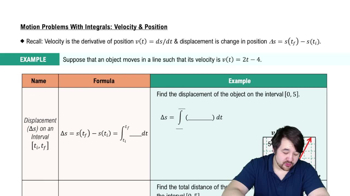
In calculus, velocity is the rate of change of position with respect to time. The position function, s(t), can be derived from the velocity function, v(t), by integrating it over time. In this case, the hiker's position at any time t can be found by integrating the given velocity function v(t) = 3 sin²(πt/2) from 0 to t.
Recommended video:
10:17
Using The Velocity Function

Integration

Integration is a fundamental concept in calculus that allows us to find the accumulated value of a function over an interval. To find the hiker's position at t=3, we need to compute the definite integral of the velocity function from 0 to 3. This process essentially sums up all the small changes in position over the specified time period.
Recommended video:
06:18
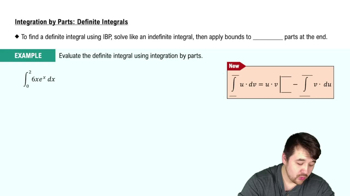
Integration by Parts for Definite Integrals

Definite Integral

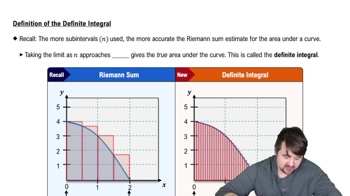
A definite integral calculates the net area under a curve between two points on the x-axis. In this context, it represents the total distance traveled by the hiker from time t=0 to t=3. The result of the definite integral will give us the hiker's position at t=3, which is crucial for answering the question.
Recommended video:
05:43
Definition of the Definite Integral
Related Practice
Textbook Question

Piecewise velocity The velocity of a (fast) automobile on a straight highway is given by the function

v(t)={3t if 0t<2060 if 20t<452404t if t45v(t)= \(\begin{cases}\)3 t & \(\text\) { if } 0 \(\leq\) t<20 \\ 60 & \(\text\) { if } 20 \(\leq\) t<45 \\ 240-4 t & \(\text\) { if } t \(\geq\) 45\(\end{cases}\)

, where is measured in seconds and v has units of m/s. 


c. What is the distance traveled by the automobile in the first 60 s?

Textbook Question

Determine whether the following statements are true and give an explanation or counterexample. 


c. Let f(x)=12x^2. The area of the surface generated when the graph of f on [−4, 4] is revolved about the x-axis is twice the area of the surface generated when the graph of f on [0, 4] is revolved about the x-axis. 

Textbook Question

Explain why or why not Determine whether the following statements are true and give an explanation or counterexample.

c. The work required to lift a 10-kg object vertically 10 m is the same as the work required to lift a 20-kg object vertically 5 m.

Textbook Question

Determine whether the following statements are true and give an explanation or counterexample.


c. ∫₀¹(x−x^2) dx=∫₀¹(√y−y) dy

2
views
Textbook Question

Compressing and stretching a spring Suppose a force of 30 N is required to stretch and hold a spring 0.2 m from its equilibrium position.

c. How much work is required to stretch the spring 0.3 m from its equilibrium position?

Textbook Question

Flying into a headwind The velocity (in mi/hr) of an airplane flying into a headwind is given by v(t) = 30(16−t²), for 0≤t≤3. Assume s(0)=0 and t is measured in hours.


c. How far has the airplane traveled at the instant its velocity reaches 400 mi/hr?