Ch. 5 - Integration
Briggs - Calculus: Early Transcendentals 3rd Edition
Briggs3rd EditionCalculus: Early TranscendentalsISBN: 9780136847243Not the one you use?Change textbook
Chapter 5, Problem 5.2.73a

{Use of Tech} Approximating definite integrals with a calculator Consider the following definite integrals.
(a) Write the left and right Riemann sums in sigma notation for an arbitrary value of n.


∫₀¹ cos ⁻¹ 𝓍 d𝓍

Verified step by step guidance
1
Step 1: Understand the problem. The goal is to approximate the definite integral ∫₀¹ cos⁻¹(𝓍) d𝓍 using Riemann sums. A Riemann sum is a method for approximating the area under a curve by dividing the interval into subintervals and summing up the areas of rectangles formed within those subintervals.
Step 2: Define the interval and subintervals. The integral is over the interval [0, 1]. Divide this interval into n subintervals of equal width. The width of each subinterval is Δ𝓍 = (1 - 0)/n = 1/n.
Step 3: Write the left Riemann sum in sigma notation. For the left Riemann sum, the height of each rectangle is determined by the function value at the left endpoint of each subinterval. The left Riemann sum can be expressed as: i1n(cos1(a....
Step 4: Right sum sigma notation
Step 5: wrap up

Verified video answer for a similar problem:

This video solution was recommended by our tutors as helpful for the problem above.
Video duration:
4m
Was this helpful?

Key Concepts

Here are the essential concepts you must grasp in order to answer the question correctly.

Definite Integrals

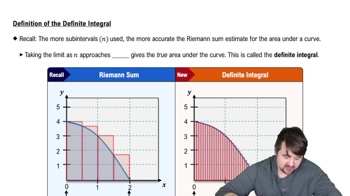
A definite integral represents the signed area under a curve between two points on the x-axis. It is denoted as ∫_a^b f(x) dx, where 'a' and 'b' are the limits of integration. The value of a definite integral can be interpreted as the accumulation of quantities, such as area, over the interval [a, b].
Recommended video:
05:43
Definition of the Definite Integral

Riemann Sums

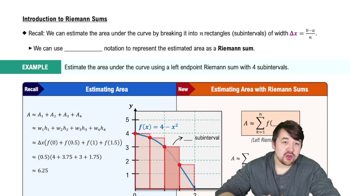
Riemann sums are a method for approximating the value of a definite integral by dividing the area under a curve into rectangles. The left Riemann sum uses the left endpoints of subintervals to determine the height of the rectangles, while the right Riemann sum uses the right endpoints. As the number of rectangles (n) increases, the Riemann sums converge to the exact value of the definite integral.
Recommended video:
06:11
Introduction to Riemann Sums

Sigma Notation

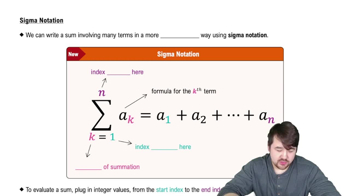
Sigma notation is a concise way to represent the sum of a sequence of terms. It uses the Greek letter sigma (Σ) to indicate summation, along with an index of summation that specifies the starting and ending values. In the context of Riemann sums, sigma notation is used to express the sum of the areas of the rectangles formed in the approximation of the integral.
Recommended video:
04:22
Sigma Notation
Related Practice
Textbook Question

{Use of Tech} Midpoint Riemann sums with a calculator Consider the following definite integrals.

(a) Write the midpoint Riemann sum in sigma notation for an arbitrary value of n.


∫₀⁴ (4𝓍― 𝓍²) d𝓍

Textbook Question

Displacement from a velocity graph Consider the velocity function for an object moving along a line (see figure).

(a) Describe the motion of the object over the interval [0,6].

1
views
Textbook Question

Properties of integrals Consider two functions ƒ and g on [1,6] such that ∫₁⁶ƒ(𝓍) d𝓍 = 10 and ∫₁⁶g(𝓍) d𝓍 = 5, ∫₄⁶ƒ(𝓍) d𝓍 = 5 , and ∫₁⁴g(𝓍) d𝓍 = 2. Evaluate the following integrals.


(a) ∫₁⁴ 3f(𝓍) d𝓍

Textbook Question

Area functions The graph of ƒ is shown in the figure. Let A(x) = ∫₀ˣ ƒ(t) dt and F(x) = ∫₂ˣ ƒ(t) dt be two area functions for ƒ. Evaluate the following area functions.

(a) A(2)

1
views
Textbook Question

Area functions for the same linear function Let ƒ(t) = 2t ― 2 and consider the two area functions A (𝓍) = ∫₁ˣ ƒ(t) dt and F(𝓍) = ∫₄ˣ ƒ(t) dt .

(a) Evaluate A (2) and A (3). Then use geometry to find an expression for A (𝓍) , for 𝓍 ≥ 1 .

1
views
Textbook Question

Planetary orbits The planets orbit the Sun in elliptical orbits with the Sun at one focus (see Section 12.4 for more on ellipses). The equation of an ellipse whose dimensions are 2a in the 𝓍-direction and 2b in the y-direction is (𝓍²/a²) + (y² /b²) = 1.

(a) Let d² denote the square of the distance from a planet to the center of the ellipse at (0, 0). Integrate over the interval [ ―a, a] to show that the average value of d² is (a² + 2b²) /3 .