Ch. 5 - Integration
Briggs - Calculus: Early Transcendentals 3rd Edition
Briggs3rd EditionCalculus: Early TranscendentalsISBN: 9780136847243Not the one you use?Change textbook
Chapter 5, Problem 5.2.55a

Properties of integrals Consider two functions ƒ and g on [1,6] such that ∫₁⁶ƒ(𝓍) d𝓍 = 10 and ∫₁⁶g(𝓍) d𝓍 = 5, ∫₄⁶ƒ(𝓍) d𝓍 = 5 , and ∫₁⁴g(𝓍) d𝓍 = 2. Evaluate the following integrals.


(a) ∫₁⁴ 3f(𝓍) d𝓍

Verified step by step guidance
1
Step 1: Recall the property of integrals that allows constants to be factored out. Specifically, for any constant c and function ƒ(𝓍), ∫ₐᵇ cƒ(𝓍) d𝓍 = c∫ₐᵇ ƒ(𝓍) d𝓍.
Step 2: Apply this property to the given integral ∫₁⁴ 3ƒ(𝓍) d𝓍. Factor out the constant 3, so the integral becomes 3∫₁⁴ ƒ(𝓍) d𝓍.
Step 3: Notice that the integral ∫₁⁴ ƒ(𝓍) d𝓍 is not directly provided in the problem. However, you can calculate it using the additive property of integrals: ∫₁⁶ ƒ(𝓍) d𝓍 = ∫₁⁴ ƒ(𝓍) d𝓍 + ∫₄⁶ ƒ(𝓍) d𝓍.
Step 4: Substitute the known values into the equation. From the problem, ∫₁⁶ ƒ(𝓍) d𝓍 = 10 and ∫₄⁶ ƒ(𝓍) d𝓍 = 5. Solve for ∫₁⁴ ƒ(𝓍) d𝓍 by subtracting: ∫₁⁴ ƒ(𝓍) d𝓍 = 10 - 5.
Step 5: Replace ∫₁⁴ ƒ(𝓍) d𝓍 in the expression 3∫₁⁴ ƒ(𝓍) d𝓍 with the calculated value from Step 4. The final integral is now expressed as 3 multiplied by the result of ∫₁⁴ ƒ(𝓍) d𝓍.

Verified video answer for a similar problem:

This video solution was recommended by our tutors as helpful for the problem above.
Video duration:
2m
Was this helpful?

Key Concepts

Here are the essential concepts you must grasp in order to answer the question correctly.

Properties of Definite Integrals

Definite integrals have several key properties, including linearity, which states that the integral of a sum of functions is the sum of their integrals. Additionally, the integral of a constant multiplied by a function can be factored out, allowing for simplification in calculations. Understanding these properties is essential for evaluating integrals efficiently.
Recommended video:
05:43
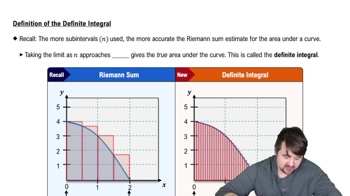
Definition of the Definite Integral

Integration of Constant Multiples

When integrating a function multiplied by a constant, the constant can be factored out of the integral. For example, ∫ₐᵇ kƒ(𝓍) d𝓍 = k∫ₐᵇ ƒ(𝓍) d𝓍, where k is a constant. This property simplifies the evaluation of integrals, making it easier to compute the area under the curve of the function multiplied by a constant.
Recommended video:
05:56
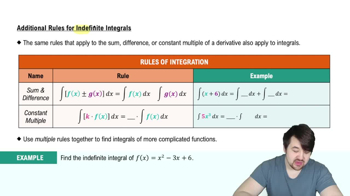
Additional Rules for Indefinite Integrals

Fundamental Theorem of Calculus

The Fundamental Theorem of Calculus connects differentiation and integration, stating that if F is an antiderivative of f on an interval [a, b], then ∫ₐᵇ f(𝓍) d𝓍 = F(b) - F(a). This theorem is crucial for evaluating definite integrals and understanding the relationship between a function and its integral over a specified interval.
Recommended video:
06:11
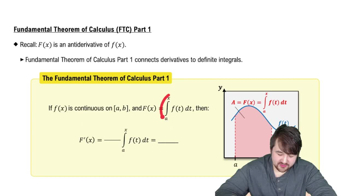
Fundamental Theorem of Calculus Part 1
Related Practice
Textbook Question

Displacement from a velocity graph Consider the velocity function for an object moving along a line (see figure).

(a) Describe the motion of the object over the interval [0,6].

1
views

Textbook Question

Explain why or why not Determine whether the following statements are true and give an explanation or counterexample.

(a) If ƒ is symmetric about the line 𝓍 = 2 , then ∫₀⁴ ƒ(𝓍) d𝓍 = 2 ∫₀² ƒ(𝓍) d𝓍.

1
views
Textbook Question

{Use of Tech} Approximating definite integrals with a calculator Consider the following definite integrals.

(a) Write the left and right Riemann sums in sigma notation for an arbitrary value of n.


∫₀¹ cos ⁻¹ 𝓍 d𝓍

Textbook Question

Free fall On October 14, 2012, Felix Baumgartner stepped off a balloon capsule at an altitude of almost 39 km above Earth’s surface and began his free fall. His velocity in m/s during the fall is given in the figure. It is claimed that Felix reached the speed of sound 34 seconds into his fall and that he continued to fall at supersonic speed for 30 seconds. (Source: http://www.redbullstratos.com)

(a) Divide the interval [34, 64] into n = 5 subintervals with the gridpoints x₀ = 34 , x₁ = 40 , x₂ = 46 , x₃ = 52 , x₄ = 58 , and x₅ = 64. Use left and right Riemann sums to estimate how far Felix fell while traveling at supersonic speed.

Textbook Question

Area functions The graph of ƒ is shown in the figure. Let A(x) = ∫₀ˣ ƒ(t) dt and F(x) = ∫₂ˣ ƒ(t) dt be two area functions for ƒ. Evaluate the following area functions.

(a) A(2)

1
views
Textbook Question

Area functions for the same linear function Let ƒ(t) = 2t ― 2 and consider the two area functions A (𝓍) = ∫₁ˣ ƒ(t) dt and F(𝓍) = ∫₄ˣ ƒ(t) dt .

(a) Evaluate A (2) and A (3). Then use geometry to find an expression for A (𝓍) , for 𝓍 ≥ 1 .

1
views