Ch. 5 - Integration
Briggs - Calculus: Early Transcendentals 3rd Edition
Briggs3rd EditionCalculus: Early TranscendentalsISBN: 9780136847243Not the one you use?Change textbook
Chapter 5, Problem 5.1.35a

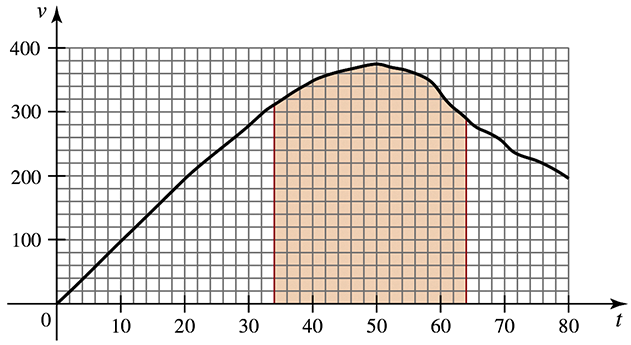
Free fall On October 14, 2012, Felix Baumgartner stepped off a balloon capsule at an altitude of almost 39 km above Earth’s surface and began his free fall. His velocity in m/s during the fall is given in the figure. It is claimed that Felix reached the speed of sound 34 seconds into his fall and that he continued to fall at supersonic speed for 30 seconds. (Source: http://www.redbullstratos.com)
(a) Divide the interval [34, 64] into n = 5 subintervals with the gridpoints x₀ = 34 , x₁ = 40 , x₂ = 46 , x₃ = 52 , x₄ = 58 , and x₅ = 64. Use left and right Riemann sums to estimate how far Felix fell while traveling at supersonic speed.

Verified step by step guidance
1
Divide the interval [34, 64] into n = 5 subintervals: [34, 40], [40, 46], [46, 52], [52, 58], and [58, 64]. Note that the width of each subinterval is Δt = 6 seconds.
For the left Riemann sum, use the velocity values at the left endpoints of each subinterval: v(34), v(40), v(46), v(52), and v(58). Multiply each velocity value by the subinterval width Δt to approximate the distance traveled in each subinterval.
For the right Riemann sum, use the velocity values at the right endpoints of each subinterval: v(40), v(46), v(52), v(58), and v(64). Multiply each velocity value by the subinterval width Δt to approximate the distance traveled in each subinterval.
Sum the results of the left Riemann sum and the right Riemann sum separately to estimate the total distance Felix fell while traveling at supersonic speed.
Compare the left and right Riemann sums to understand the range of possible distances traveled during the interval [34, 64].

Verified video answer for a similar problem:

This video solution was recommended by our tutors as helpful for the problem above.
Video duration:
4m
Was this helpful?

Key Concepts

Here are the essential concepts you must grasp in order to answer the question correctly.

Riemann Sums

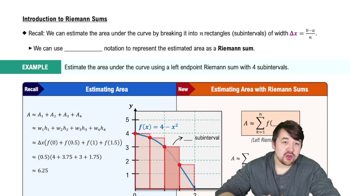
Riemann sums are a method for approximating the total area under a curve by dividing it into smaller subintervals. In this context, the left and right Riemann sums use the function values at the left and right endpoints of each subinterval to estimate the area, which corresponds to the distance fallen by Felix during his supersonic speed. This technique is fundamental in calculus for understanding integration.
Recommended video:
06:11
Introduction to Riemann Sums

Velocity and Distance Relationship

The relationship between velocity and distance is crucial in understanding motion. Velocity, defined as the rate of change of position with respect to time, can be integrated over a time interval to find the total distance traveled. In this problem, the area under the velocity-time graph during the specified interval represents the distance Felix fell while traveling at supersonic speed.
Recommended video:
10:17
Using The Velocity Function

Supersonic Speed

Supersonic speed refers to speeds that exceed the speed of sound, which is approximately 343 m/s at sea level. In the context of Felix's fall, understanding supersonic speed is essential as it indicates the phase of his fall where he traveled faster than sound. This concept is important for interpreting the velocity graph and calculating the distance fallen during that specific time frame.
Recommended video:
06:29
Derivatives Applied To Velocity
Related Practice
Textbook Question

Displacement from a velocity graph Consider the velocity function for an object moving along a line (see figure).

(a) Describe the motion of the object over the interval [0,6].

1
views

Textbook Question

Explain why or why not Determine whether the following statements are true and give an explanation or counterexample.

(a) If ƒ is symmetric about the line 𝓍 = 2 , then ∫₀⁴ ƒ(𝓍) d𝓍 = 2 ∫₀² ƒ(𝓍) d𝓍.

1
views
Textbook Question

Use Table 5.6 to evaluate the following indefinite integrals.                                                                                                               


 (b) ∫ sec 5𝓍 tan 5𝓍 d𝓍

Textbook Question

Displacement from a velocity graph Consider the velocity function for an object moving along a line (see figure).

(b) Use geometry to find the displacement of the object between t = 0 and t = 2.

1
views
Textbook Question

Properties of integrals Consider two functions ƒ and g on [1,6] such that ∫₁⁶ƒ(𝓍) d𝓍 = 10 and ∫₁⁶g(𝓍) d𝓍 = 5, ∫₄⁶ƒ(𝓍) d𝓍 = 5 , and ∫₁⁴g(𝓍) d𝓍 = 2. Evaluate the following integrals.


(a) ∫₁⁴ 3f(𝓍) d𝓍

Textbook Question

Area functions The graph of ƒ is shown in the figure. Let A(x) = ∫₀ˣ ƒ(t) dt and F(x) = ∫₂ˣ ƒ(t) dt be two area functions for ƒ. Evaluate the following area functions.

(a) A(2)

1
views