
Textbook Question
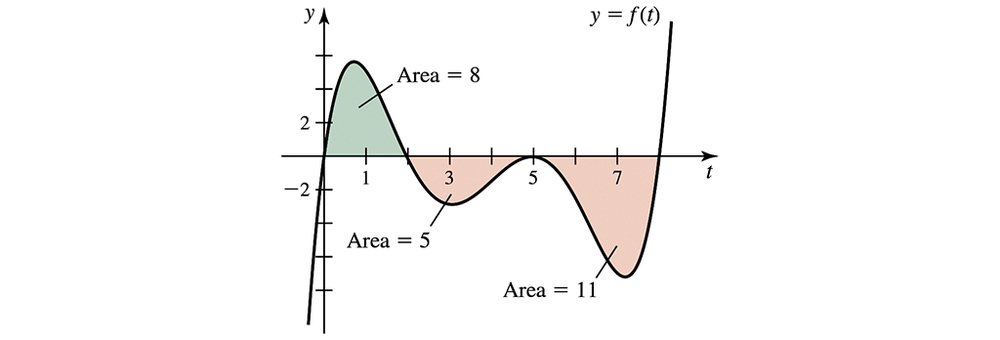
Displacement from a velocity graph Consider the velocity function for an object moving along a line (see figure).
(a) Describe the motion of the object over the interval [0,6].
1
views

 Verified step by step guidance
 05:43
05:43
 05:06
05:06 06:11
06:11Displacement from a velocity graph Consider the velocity function for an object moving along a line (see figure).
(a) Describe the motion of the object over the interval [0,6].
Explain why or why not Determine whether the following statements are true and give an explanation or counterexample.
(a) If ƒ is symmetric about the line 𝓍 = 2 , then ∫₀⁴ ƒ(𝓍) d𝓍 = 2 ∫₀² ƒ(𝓍) d𝓍.
Displacement from a velocity graph Consider the velocity function for an object moving along a line (see figure).
(b) Use geometry to find the displacement of the object between t = 0 and t = 2.
{Use of Tech} Approximating definite integrals with a calculator Consider the following definite integrals.
(a) Write the left and right Riemann sums in sigma notation for an arbitrary value of n.
∫₀¹ cos ⁻¹ 𝓍 d𝓍
Properties of integrals Consider two functions ƒ and g on [1,6] such that ∫₁⁶ƒ(𝓍) d𝓍 = 10 and ∫₁⁶g(𝓍) d𝓍 = 5, ∫₄⁶ƒ(𝓍) d𝓍 = 5 , and ∫₁⁴g(𝓍) d𝓍 = 2. Evaluate the following integrals.
(a) ∫₁⁴ 3f(𝓍) d𝓍
Free fall On October 14, 2012, Felix Baumgartner stepped off a balloon capsule at an altitude of almost 39 km above Earth’s surface and began his free fall. His velocity in m/s during the fall is given in the figure. It is claimed that Felix reached the speed of sound 34 seconds into his fall and that he continued to fall at supersonic speed for 30 seconds. (Source: http://www.redbullstratos.com)
(a) Divide the interval [34, 64] into n = 5 subintervals with the gridpoints x₀ = 34 , x₁ = 40 , x₂ = 46 , x₃ = 52 , x₄ = 58 , and x₅ = 64. Use left and right Riemann sums to estimate how far Felix fell while traveling at supersonic speed.