Ch. 5 - Integration
Briggs - Calculus: Early Transcendentals 3rd Edition
Briggs3rd EditionCalculus: Early TranscendentalsISBN: 9780136847243Not the one you use?Change textbook
Chapter 5, Problem 5.3.18a

Area functions for the same linear function Let ƒ(t) = 2t ― 2 and consider the two area functions A (𝓍) = ∫₁ˣ ƒ(t) dt and F(𝓍) = ∫₄ˣ ƒ(t) dt .
(a) Evaluate A (2) and A (3). Then use geometry to find an expression for A (𝓍) , for 𝓍 ≥ 1 .

Verified step by step guidance
1
Step 1: Understand the problem. We are given a linear function ƒ(t) = 2t - 2 and two area functions A(𝓍) = ∫₁ˣ ƒ(t) dt and F(𝓍) = ∫₄ˣ ƒ(t) dt. The goal is to evaluate A(2) and A(3), and then find a general expression for A(𝓍) using geometry for 𝓍 ≥ 1.
Step 2: To evaluate A(2) and A(3), compute the definite integrals. For A(2), calculate ∫₁² (2t - 2) dt. For A(3), calculate ∫₁³ (2t - 2) dt. Use the formula for the definite integral of a linear function: ∫ (at + b) dt = (a/2)t² + bt + C.
Step 3: Apply the limits of integration to the results from Step 2. For example, after integrating ƒ(t), substitute the upper limit (𝓍 = 2 or 𝓍 = 3) and subtract the value of the integral at the lower limit (𝓍 = 1). This will give the values of A(2) and A(3).
Step 4: To find a general expression for A(𝓍) for 𝓍 ≥ 1, use geometry. The graph of ƒ(t) = 2t - 2 is a straight line. The area under the curve from t = 1 to t = 𝓍 forms a trapezoid or triangle, depending on the value of 𝓍. Use the formula for the area of a trapezoid or triangle to express A(𝓍) geometrically.
Step 5: Write the general expression for A(𝓍) based on the geometric interpretation. For example, if the area forms a trapezoid, use the formula A = (1/2)(base1 + base2)(height). If it forms a triangle, use A = (1/2)(base)(height). Ensure the expression is valid for 𝓍 ≥ 1.

Verified video answer for a similar problem:

This video solution was recommended by our tutors as helpful for the problem above.
Video duration:
3m
Was this helpful?

Key Concepts

Here are the essential concepts you must grasp in order to answer the question correctly.

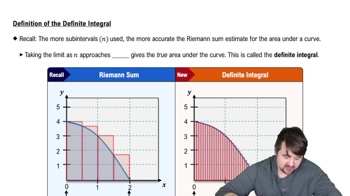
Definite Integrals

Definite integrals represent the signed area under a curve defined by a function over a specific interval. In this context, A(x) and F(x) are defined as the definite integrals of the function ƒ(t) from different lower limits to x. Evaluating these integrals involves calculating the area under the curve from the lower limit to the upper limit, which is essential for finding A(2) and A(3).
Recommended video:
05:43
Definition of the Definite Integral

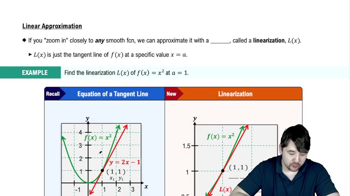
Area Under a Linear Function

The function ƒ(t) = 2t - 2 is a linear function, which means its graph is a straight line. The area under a linear function can be calculated using geometric shapes, such as triangles and rectangles. For the area function A(x), understanding the geometric interpretation allows for easier evaluation and expression of the area as a function of x, particularly for x ≥ 1.
Recommended video:
07:17
Linearization

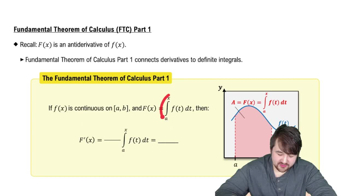
Fundamental Theorem of Calculus

The Fundamental Theorem of Calculus links the concept of differentiation and integration, stating that if F is an antiderivative of f on an interval, then the definite integral of f from a to b can be computed as F(b) - F(a). This theorem is crucial for evaluating the area functions A(x) and F(x) since it allows us to find the values of these integrals by determining the antiderivative of the function ƒ(t) and applying the limits of integration.
Recommended video:
06:11
Fundamental Theorem of Calculus Part 1
Related Practice
Textbook Question

{Use of Tech} Midpoint Riemann sums with a calculator Consider the following definite integrals.

(a) Write the midpoint Riemann sum in sigma notation for an arbitrary value of n.


∫₀⁴ (4𝓍― 𝓍²) d𝓍

Textbook Question

Displacement from a velocity graph Consider the velocity function for an object moving along a line (see figure).

(a) Describe the motion of the object over the interval [0,6].

1
views
Textbook Question

{Use of Tech} Approximating definite integrals with a calculator Consider the following definite integrals.

(a) Write the left and right Riemann sums in sigma notation for an arbitrary value of n.


∫₀¹ cos ⁻¹ 𝓍 d𝓍

Textbook Question

Properties of integrals Consider two functions ƒ and g on [1,6] such that ∫₁⁶ƒ(𝓍) d𝓍 = 10 and ∫₁⁶g(𝓍) d𝓍 = 5, ∫₄⁶ƒ(𝓍) d𝓍 = 5 , and ∫₁⁴g(𝓍) d𝓍 = 2. Evaluate the following integrals.


(a) ∫₁⁴ 3f(𝓍) d𝓍

Textbook Question

Properties of integrals Use only the fact that ∫₀⁴ 3𝓍 (4 ―𝓍) d𝓍 = 32, and the definitions and properties of integrals, to evaluate the following integrals, if possible.

(a) ∫₄⁰ 3𝓍(4 ― 𝓍) d(𝓍)

Textbook Question

Planetary orbits The planets orbit the Sun in elliptical orbits with the Sun at one focus (see Section 12.4 for more on ellipses). The equation of an ellipse whose dimensions are 2a in the 𝓍-direction and 2b in the y-direction is (𝓍²/a²) + (y² /b²) = 1.

(a) Let d² denote the square of the distance from a planet to the center of the ellipse at (0, 0). Integrate over the interval [ ―a, a] to show that the average value of d² is (a² + 2b²) /3 .