
Textbook Question
Displacement from a velocity graph Consider the velocity function for an object moving along a line (see figure).
(a) Describe the motion of the object over the interval [0,6].
1
views

 Verified step by step guidance
 07:39
07:39
 04:22
04:22 05:43
05:43Displacement from a velocity graph Consider the velocity function for an object moving along a line (see figure).
(a) Describe the motion of the object over the interval [0,6].
{Use of Tech} Approximating definite integrals with a calculator Consider the following definite integrals.
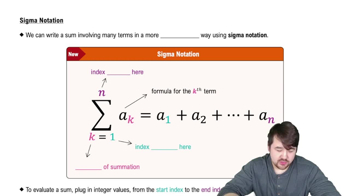
(a) Write the left and right Riemann sums in sigma notation for an arbitrary value of n.
∫₀¹ cos ⁻¹ 𝓍 d𝓍
Area functions for the same linear function Let ƒ(t) = 2t ― 2 and consider the two area functions A (𝓍) = ∫₁ˣ ƒ(t) dt and F(𝓍) = ∫₄ˣ ƒ(t) dt .
(a) Evaluate A (2) and A (3). Then use geometry to find an expression for A (𝓍) , for 𝓍 ≥ 1 .
Properties of integrals Use only the fact that ∫₀⁴ 3𝓍 (4 ―𝓍) d𝓍 = 32, and the definitions and properties of integrals, to evaluate the following integrals, if possible.
(a) ∫₄⁰ 3𝓍(4 ― 𝓍) d(𝓍)
Substitutions Suppose ƒ is an even function with ∫₀⁸ ƒ(𝓍) d𝓍 = 9 . Evaluate each integral.
(a) ∫¹₋₁ 𝓍ƒ(𝓍²) d𝓍
Planetary orbits The planets orbit the Sun in elliptical orbits with the Sun at one focus (see Section 12.4 for more on ellipses). The equation of an ellipse whose dimensions are 2a in the 𝓍-direction and 2b in the y-direction is (𝓍²/a²) + (y² /b²) = 1.
(a) Let d² denote the square of the distance from a planet to the center of the ellipse at (0, 0). Integrate over the interval [ ―a, a] to show that the average value of d² is (a² + 2b²) /3 .