Ch. 5 The Integumentary System
Amerman- Human Anatomy & Physiology 3e
Amerman3rd EditionHuman Anatomy & PhysiologyISBN: 9780138247201, 9780138247928, 9780138201814Not the one you use?Change textbook
Chapter 5, Problem L3.A3a

Nguyen comes to your clinic with a mole that has recently changed in appearance. You examine the mole and note that its borders are irregular, it has a deep blue-black color, and the color is unevenly distributed throughout the mole.
What is your immediate concern? Why?

Verified step by step guidance
1
Step 1: Begin by identifying the key characteristics of the mole described in the problem. These include irregular borders, deep blue-black color, and uneven color distribution. These features are clinically significant and should raise concern.
Step 2: Recall the ABCDE criteria for evaluating moles, which are commonly used to assess potential melanoma. The criteria include: A - Asymmetry, B - Border irregularity, C - Color variation, D - Diameter greater than 6mm, and E - Evolving changes in size, shape, or color.
Step 3: Compare the mole's features to the ABCDE criteria. Irregular borders and uneven color distribution align with the 'B' and 'C' criteria, while the deep blue-black color may indicate abnormal pigmentation. These findings suggest the mole could be suspicious for melanoma.
Step 4: Consider the urgency of the situation. Melanoma is a type of skin cancer that can spread rapidly if not treated early. The described changes in the mole's appearance are concerning and warrant immediate medical evaluation.
Step 5: Recommend the next steps for Nguyen. Advise a biopsy or referral to a dermatologist for further examination and diagnostic testing to confirm whether the mole is malignant. Early detection and treatment are critical for improving outcomes.

Verified video answer for a similar problem:

This video solution was recommended by our tutors as helpful for the problem above.
Was this helpful?

Key Concepts

Here are the essential concepts you must grasp in order to answer the question correctly.

Melanoma

Melanoma is a type of skin cancer that develops from melanocytes, the cells responsible for producing melanin, which gives skin its color. It is known for its aggressive nature and potential to metastasize, making early detection crucial. The characteristics of moles, such as irregular borders and uneven color, are key indicators of melanoma, necessitating immediate medical evaluation.
Recommended video:
02:47
Map of the Lesson on Integumentary System

ABCDE Rule

The ABCDE rule is a guideline for identifying the warning signs of melanoma. It stands for Asymmetry, Border irregularity, Color variation, Diameter greater than 6mm, and Evolving changes. Each of these criteria helps in assessing moles for potential malignancy, and the presence of irregular borders and uneven color in Nguyen's mole raises significant concern for melanoma.
Recommended video:
02:52
Octet Rule

Skin Examination

A skin examination is a thorough assessment of the skin to identify any abnormalities, such as moles or lesions that may indicate skin cancer. This process involves visual inspection and may include dermatoscopy for a more detailed view. In Nguyen's case, the examination reveals critical features that warrant immediate concern and further investigation to rule out malignancy.
Recommended video:
4:08
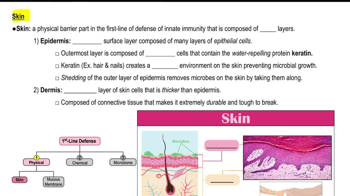
Skin