Ch. 5 The Integumentary System
Amerman- Human Anatomy & Physiology 3e
Amerman3rd EditionHuman Anatomy & PhysiologyISBN: 9780138247201, 9780138247928, 9780138201814Not the one you use?Change textbook
Chapter 5, Problem 5

Number the strata of thick skin epidermis from deepest (1) to most superficial (5). 
____Stratum spinosum     
____Stratum corneum     
____Stratum basale     
____Stratum lucidum     
____Stratum granulosum

Verified step by step guidance
1
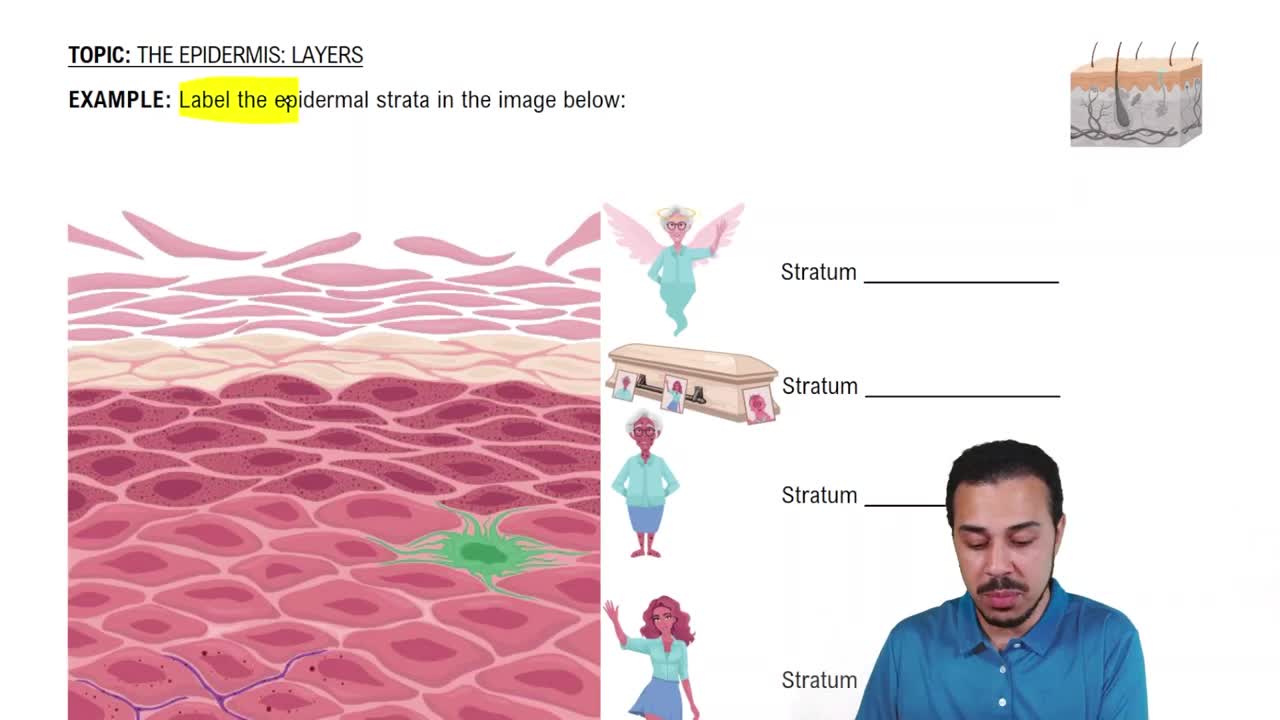
Understand that the epidermis of thick skin consists of five distinct layers, arranged from deepest to most superficial. These layers are: Stratum basale, Stratum spinosum, Stratum granulosum, Stratum lucidum, and Stratum corneum.
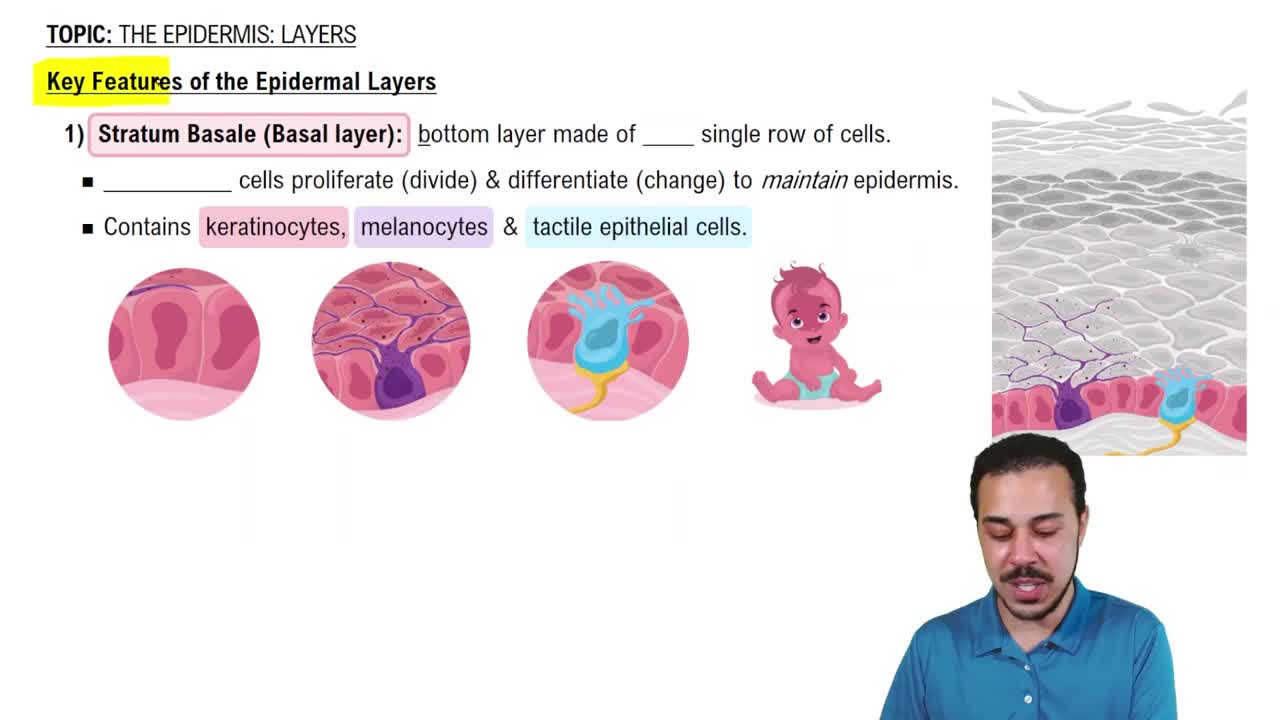
Identify the Stratum basale as the deepest layer. It is a single layer of cells that includes keratinocytes, melanocytes, and Merkel cells, and is responsible for cell division and regeneration.
Next, recognize the Stratum spinosum as the layer above the Stratum basale. It consists of several layers of keratinocytes connected by desmosomes, giving it a spiny appearance under a microscope.
Above the Stratum spinosum is the Stratum granulosum. This layer contains keratinocytes that begin to die and accumulate keratohyalin granules, which contribute to the waterproofing of the skin.
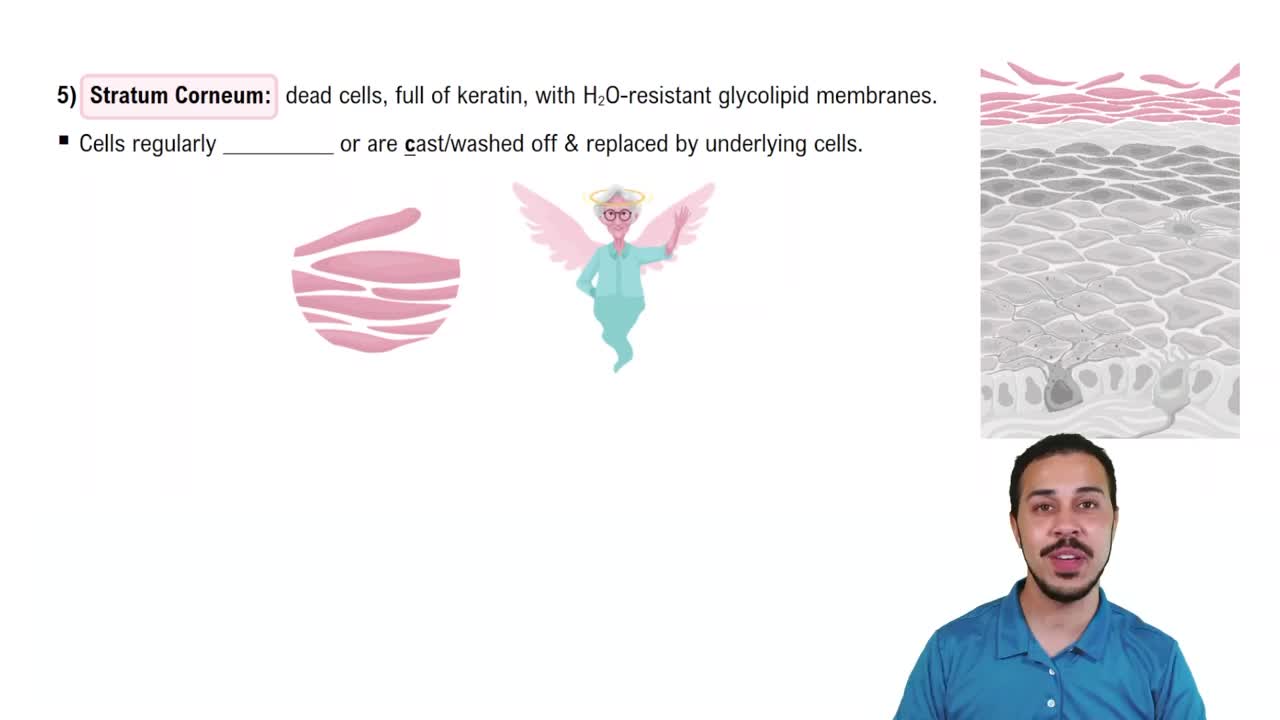
The Stratum lucidum is found only in thick skin (e.g., palms and soles) and lies above the Stratum granulosum. It is a thin, translucent layer of dead keratinocytes. The most superficial layer is the Stratum corneum, consisting of dead, flattened keratinocytes that form a protective barrier against environmental damage.

Verified video answer for a similar problem:

This video solution was recommended by our tutors as helpful for the problem above.
Was this helpful?

Key Concepts

Here are the essential concepts you must grasp in order to answer the question correctly.

Epidermis Layers

The epidermis is the outermost layer of skin, composed of five distinct strata in thick skin. These layers include the stratum basale (deepest), stratum spinosum, stratum granulosum, stratum lucidum, and stratum corneum (most superficial). Each layer has unique characteristics and functions, contributing to the skin's overall health and protection.
Recommended video:
04:09
The Epidermis: Layers Example 2

Stratum Basale

The stratum basale, or basal layer, is the deepest layer of the epidermis where new skin cells are generated. It consists of a single row of columnar or cuboidal keratinocytes that are actively dividing. This layer is crucial for skin regeneration and contains melanocytes, which produce melanin, contributing to skin pigmentation.
Recommended video:
04:52
Epidermal Layers: Stratum Basale (Basal Layer)

Stratum Corneum

The stratum corneum is the outermost layer of the epidermis, composed of dead, flattened keratinocytes that form a protective barrier. This layer is essential for preventing water loss and protecting underlying tissues from environmental damage. It is continuously shed and replaced, playing a vital role in skin homeostasis.
Recommended video:
03:18
Epidermal Layers: Stratum Corneum