Ch. 5 The Integumentary System
Amerman- Human Anatomy & Physiology 3e
Amerman3rd EditionHuman Anatomy & PhysiologyISBN: 9780138247201, 9780138247928, 9780138201814Not the one you use?Change textbook
Chapter 5, Problem L3.B5c

Many antiaging skin creams contain collagen and hyaluronic acid. Manufacturers claim that the collagen and hyaluronic acid applied to the surface of the skin will be absorbed into the dermis, where they will be incorporated into dermal tissue.
Predict whether or not these substances are likely to be absorbed by the epidermis.

Verified step by step guidance
1
Understand the structure of the skin: The skin is composed of three main layers—epidermis, dermis, and hypodermis. The epidermis is the outermost layer and acts as a protective barrier. It is primarily made up of keratinized cells and is relatively impermeable to large molecules.
Examine the properties of collagen and hyaluronic acid: Collagen is a large protein molecule, and hyaluronic acid is a large polysaccharide. Both are hydrophilic (water-attracting) and have high molecular weights, which makes it difficult for them to penetrate the skin barrier.
Analyze the role of the stratum corneum: The stratum corneum is the outermost layer of the epidermis and is composed of dead, flattened keratinocytes embedded in a lipid matrix. This layer is highly selective and primarily allows the passage of small, lipophilic (fat-soluble) molecules, not large hydrophilic molecules like collagen and hyaluronic acid.
Consider the mechanism of absorption: For a substance to be absorbed into the dermis, it must first pass through the epidermis. Due to the size and hydrophilic nature of collagen and hyaluronic acid, they are unlikely to penetrate the stratum corneum and reach the dermis.
Conclude based on evidence: Based on the structure of the skin and the properties of collagen and hyaluronic acid, it is unlikely that these substances applied topically will be absorbed into the dermis and incorporated into dermal tissue. Instead, their effects are likely limited to the surface of the skin, where they may provide temporary hydration or a smoothing effect.

Verified video answer for a similar problem:

This video solution was recommended by our tutors as helpful for the problem above.
Was this helpful?

Key Concepts

Here are the essential concepts you must grasp in order to answer the question correctly.

Epidermis and Dermis Structure

The skin is composed of two primary layers: the epidermis and the dermis. The epidermis is the outermost layer, primarily made up of keratinocytes, and serves as a barrier to protect underlying tissues. The dermis lies beneath the epidermis and contains connective tissue, blood vessels, and other structures. Understanding the structural differences between these layers is crucial for predicting the absorption of substances.
Recommended video:
3:00
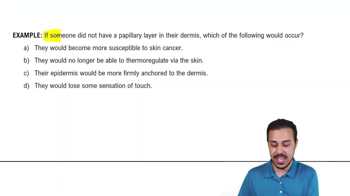
The Dermis Example 1

Molecular Size and Skin Absorption

The ability of substances to penetrate the skin depends significantly on their molecular size and properties. Larger molecules, such as collagen, typically cannot pass through the epidermis due to its dense structure. In contrast, smaller molecules or those with specific properties may be absorbed more easily. This concept is essential for evaluating the effectiveness of topical applications like skin creams.
Recommended video:
4:08
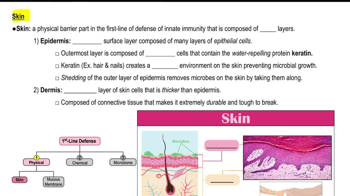
Skin

Function of Hyaluronic Acid

Hyaluronic acid is a naturally occurring substance in the body known for its ability to retain moisture and provide volume to the skin. While it is often included in skin creams for its hydrating properties, its effectiveness when applied topically depends on its molecular weight. Lower molecular weight hyaluronic acid can penetrate the skin better than higher molecular weight forms, influencing its potential absorption and efficacy in skincare products.
Recommended video:
02:45
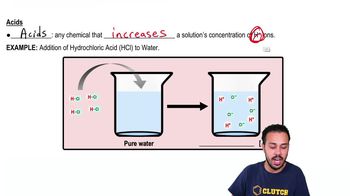
Acids
Related Practice
Textbook Question

Would a mild second-degree burn be likely to heal by regeneration or fibrosis? Would the same type of healing take place in a third-degree burn that involved muscle tissue? Why or why not?

2
views

Textbook Question

The disease pemphigus vulgaris involves a patient's own immune system attacking the desmosomes between the epithelial cells of the skin. What changes would you expect to see with this disease?

1
views
Textbook Question

Many antiaging skin creams contain collagen and hyaluronic acid. Manufacturers claim that the collagen and hyaluronic acid applied to the surface of the skin will be absorbed into the dermis, where they will be incorporated into dermal tissue.

Predict the effectiveness of the creams.

1
views
Textbook Question

Another feature of CIPA is anhidrosis, or the inability to sweat. Explain why Maria's inability to produce sweat could potentially be life-threatening.

1
views
Textbook Question

Nguyen comes to your clinic with a mole that has recently changed in appearance. You examine the mole and note that its borders are irregular, it has a deep blue-black color, and the color is unevenly distributed throughout the mole.

Nguyen tells you that she has used a tanning booth once per week for the past several years and that the tanning salon advertises it as safe. What do you tell her about the tanning salon's claim? How does any UV exposure affect keratinocytes and melanocytes? Explain.

2
views
1
rank
Textbook Question

Nguyen comes to your clinic with a mole that has recently changed in appearance. You examine the mole and note that its borders are irregular, it has a deep blue-black color, and the color is unevenly distributed throughout the mole.

What is your immediate concern? Why?

2
views