Ch. 5 The Integumentary System
Amerman- Human Anatomy & Physiology 3e
Amerman3rd EditionHuman Anatomy & PhysiologyISBN: 9780138247201, 9780138247928, 9780138201814Not the one you use?Change textbook
Chapter 5, Problem L3.A3b

Nguyen comes to your clinic with a mole that has recently changed in appearance. You examine the mole and note that its borders are irregular, it has a deep blue-black color, and the color is unevenly distributed throughout the mole.
Nguyen tells you that she has used a tanning booth once per week for the past several years and that the tanning salon advertises it as safe. What do you tell her about the tanning salon's claim? How does any UV exposure affect keratinocytes and melanocytes? Explain.

Verified step by step guidance
1
Explain to Nguyen that the tanning salon's claim of being 'safe' is misleading. UV radiation, whether from the sun or tanning booths, is a known carcinogen and can damage skin cells, increasing the risk of skin cancer, including melanoma.
Discuss how UV radiation affects keratinocytes, the primary cells in the epidermis. UV exposure can cause DNA damage in keratinocytes, leading to mutations. If these mutations are not repaired, they can result in uncontrolled cell growth and potentially skin cancer.
Explain the role of melanocytes, which are responsible for producing melanin, the pigment that gives skin its color. UV exposure stimulates melanocytes to produce more melanin as a protective response, leading to tanning. However, excessive UV exposure can damage melanocytes, causing mutations that may lead to melanoma.
Describe the warning signs of melanoma using the ABCDE rule: Asymmetry, Border irregularity, Color variation, Diameter greater than 6 mm, and Evolving size, shape, or color. Nguyen's mole exhibits several of these signs, such as irregular borders and uneven color distribution, which are concerning.
Advise Nguyen to avoid further UV exposure, including tanning booths, and to consult a dermatologist for a thorough evaluation of the mole. Early detection and treatment are critical for managing potential skin cancers like melanoma.

Verified video answer for a similar problem:

This video solution was recommended by our tutors as helpful for the problem above.
Was this helpful?

Key Concepts

Here are the essential concepts you must grasp in order to answer the question correctly.

Tanning Booths and UV Exposure

Tanning booths emit ultraviolet (UV) radiation, which can be classified into UVA and UVB rays. UVA rays penetrate the skin more deeply and are primarily responsible for skin aging and long-term skin damage, while UVB rays cause sunburn and play a significant role in developing skin cancer. Despite claims of safety, any exposure to UV radiation increases the risk of skin damage and malignancies, including melanoma.
Recommended video:
2:30
Innate Immunity

Keratinocytes

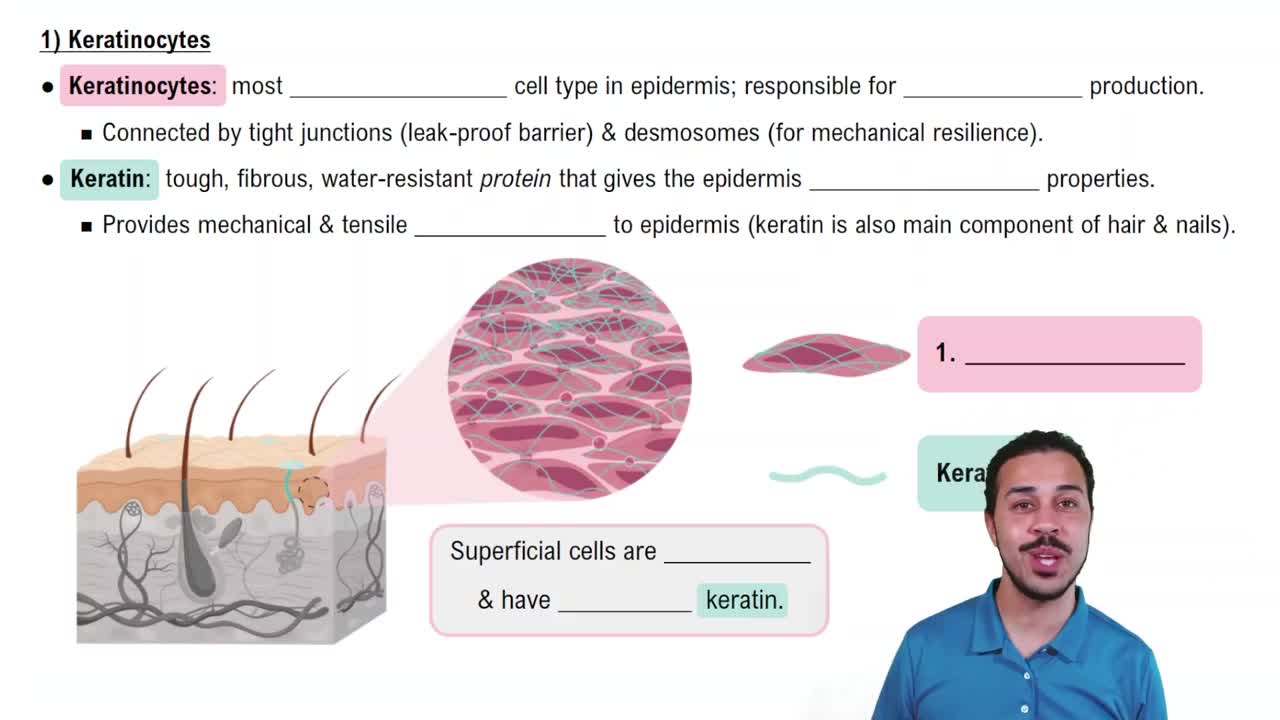
Keratinocytes are the predominant cell type in the epidermis, the outermost layer of the skin. They play a crucial role in forming a protective barrier against environmental damage, including UV radiation. When exposed to UV light, keratinocytes can undergo changes that lead to inflammation, DNA damage, and, over time, an increased risk of skin cancer due to mutations.
Recommended video:
04:22
Keratinocytes

Melanocytes and Melanin Production

Melanocytes are specialized skin cells responsible for producing melanin, the pigment that gives skin its color and provides some protection against UV radiation. When the skin is exposed to UV light, melanocytes increase melanin production as a defense mechanism, leading to tanning. However, excessive UV exposure can damage melanocytes, leading to irregularities in pigmentation and an increased risk of skin cancers, including melanoma.
Recommended video:
07:25
Total Products for Each Stage of Aerobic Cellular Respiration
Related Practice
Textbook Question

Would a mild second-degree burn be likely to heal by regeneration or fibrosis? Would the same type of healing take place in a third-degree burn that involved muscle tissue? Why or why not?

2
views

Textbook Question

The disease pemphigus vulgaris involves a patient's own immune system attacking the desmosomes between the epithelial cells of the skin. What changes would you expect to see with this disease?

1
views
Textbook Question

Many antiaging skin creams contain collagen and hyaluronic acid. Manufacturers claim that the collagen and hyaluronic acid applied to the surface of the skin will be absorbed into the dermis, where they will be incorporated into dermal tissue.

Predict whether or not these substances are likely to be absorbed by the epidermis.

1
views
Textbook Question

Many antiaging skin creams contain collagen and hyaluronic acid. Manufacturers claim that the collagen and hyaluronic acid applied to the surface of the skin will be absorbed into the dermis, where they will be incorporated into dermal tissue.

Predict the effectiveness of the creams.

1
views
Textbook Question

Another feature of CIPA is anhidrosis, or the inability to sweat. Explain why Maria's inability to produce sweat could potentially be life-threatening.

1
views
Textbook Question

After Ramon's skin came into contact with a poison ivy plant in biology lab, he developed a painful, itchy rash. However, after the skin of his colleague Cathy came into contact with snake venom in the lab, she developed no skin irritation. Poison ivy plants contain lipid-soluble oils, whereas snake venoms contain mostly water-soluble peptides. Explain why Ramon developed a rash, whereas Cathy did not.

5
views