Ch. 4 - Laws of Sines and Cosines; Vectors
Blitzer - Trigonometry 3rd Edition
Blitzer3rd EditionTrigonometryISBN: 9780137316601Not the one you use?Change textbook
Chapter 4, Problem 61

In Exercises 61–64, find the magnitude ||v||, to the nearest hundredth, and the direction angle θ, to the nearest tenth of a degree, for each given vector v. v = -10i + 15j

Verified step by step guidance
1
Identify the components of the vector \( \mathbf{v} = -10\mathbf{i} + 15\mathbf{j} \). Here, the \( x \)-component is \( -10 \) and the \( y \)-component is \( 15 \).
Calculate the magnitude \( ||\mathbf{v}|| \) of the vector using the formula for the length of a vector in two dimensions: \[ ||\mathbf{v}|| = \sqrt{(-10)^2 + 15^2} \]
Find the direction angle \( \theta \) of the vector relative to the positive \( x \)-axis using the inverse tangent function: \[ \theta = \tan^{-1} \left( \frac{15}{-10} \right) \]
Since the \( x \)-component is negative and the \( y \)-component is positive, the vector lies in the second quadrant. Adjust the angle \( \theta \) accordingly by adding 180 degrees if necessary to get the correct direction angle measured counterclockwise from the positive \( x \)-axis.
Express the final answers: the magnitude \( ||\mathbf{v}|| \) rounded to the nearest hundredth, and the direction angle \( \theta \) rounded to the nearest tenth of a degree.

Verified video answer for a similar problem:

This video solution was recommended by our tutors as helpful for the problem above.
Video duration:
2m
Was this helpful?

Key Concepts

Here are the essential concepts you must grasp in order to answer the question correctly.

Vector Magnitude

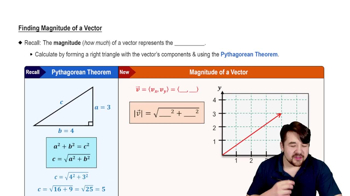
The magnitude of a vector represents its length and is calculated using the Pythagorean theorem. For a vector v = ai + bj, the magnitude ||v|| is √(a² + b²). This gives a non-negative scalar value indicating the vector's size regardless of direction.
Recommended video:
04:44
Finding Magnitude of a Vector

Direction Angle of a Vector

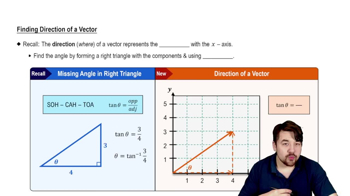
The direction angle θ of a vector in the plane is the angle it makes with the positive x-axis, measured counterclockwise. It can be found using θ = arctan(b/a), adjusting for the correct quadrant based on the signs of a and b to ensure an accurate angle between 0° and 360°.
Recommended video:
05:13
Finding Direction of a Vector

Component Form of Vectors

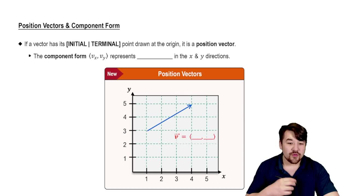
Vectors in two dimensions are often expressed in component form as v = ai + bj, where a and b are the horizontal and vertical components, respectively. Understanding these components is essential for calculating magnitude and direction, as they represent the vector's projection on the coordinate axes.
Recommended video:
03:55
Position Vectors & Component Form