Ch. 4 - Laws of Sines and Cosines; Vectors
Blitzer - Trigonometry 3rd Edition
Blitzer3rd EditionTrigonometryISBN: 9780137316601Not the one you use?Change textbook
Chapter 4, Problem 53

In Exercises 53–56, letu = -2i + 3j, v = 6i - j, w = -3i.Find each specified vector or scalar.4u - (2v - w)

Verified step by step guidance
1
Identify the given vectors: \( \mathbf{u} = -2\mathbf{i} + 3\mathbf{j} \), \( \mathbf{v} = 6\mathbf{i} - \mathbf{j} \), and \( \mathbf{w} = -3\mathbf{i} \).
Calculate \( 2\mathbf{v} \) by multiplying each component of \( \mathbf{v} \) by 2: \( 2\mathbf{v} = 2(6\mathbf{i} - \mathbf{j}) = 12\mathbf{i} - 2\mathbf{j} \).
Subtract \( \mathbf{w} \) from \( 2\mathbf{v} \): \( 2\mathbf{v} - \mathbf{w} = (12\mathbf{i} - 2\mathbf{j}) - (-3\mathbf{i}) = 12\mathbf{i} - 2\mathbf{j} + 3\mathbf{i} = 15\mathbf{i} - 2\mathbf{j} \).
Calculate \( 4\mathbf{u} \) by multiplying each component of \( \mathbf{u} \) by 4: \( 4\mathbf{u} = 4(-2\mathbf{i} + 3\mathbf{j}) = -8\mathbf{i} + 12\mathbf{j} \).
Subtract \( (2\mathbf{v} - \mathbf{w}) \) from \( 4\mathbf{u} \): \( 4\mathbf{u} - (2\mathbf{v} - \mathbf{w}) = (-8\mathbf{i} + 12\mathbf{j}) - (15\mathbf{i} - 2\mathbf{j}) = -8\mathbf{i} + 12\mathbf{j} - 15\mathbf{i} + 2\mathbf{j} = -23\mathbf{i} + 14\mathbf{j} \).

Verified video answer for a similar problem:

This video solution was recommended by our tutors as helpful for the problem above.
Video duration:
5m
Was this helpful?

Key Concepts

Here are the essential concepts you must grasp in order to answer the question correctly.

Vector Operations

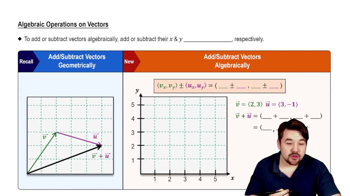
Vector operations include addition, subtraction, and scalar multiplication. In this context, vectors are treated as quantities with both magnitude and direction, represented in component form. Understanding how to manipulate vectors through these operations is essential for solving problems involving multiple vectors.
Recommended video:
04:12
Algebraic Operations on Vectors

Scalar Multiplication

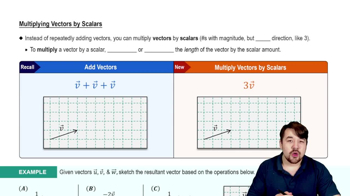
Scalar multiplication involves multiplying a vector by a scalar (a real number), which scales the vector's magnitude without changing its direction. For example, multiplying the vector u = -2i + 3j by a scalar 4 results in the vector -8i + 12j. This concept is crucial for transforming vectors in the given expression.
Recommended video:
05:05
Multiplying Vectors By Scalars

Vector Subtraction

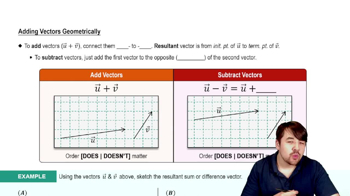
Vector subtraction is the process of finding the difference between two vectors, which can be visualized as adding the negative of one vector to another. For instance, subtracting vector w from 2v involves changing the direction of w and then adding it to 2v. This operation is key to simplifying the expression in the problem.
Recommended video:
05:29
Adding Vectors Geometrically