Ch. 4 - Laws of Sines and Cosines; Vectors
Blitzer - Trigonometry 3rd Edition
Blitzer3rd EditionTrigonometryISBN: 9780137316601Not the one you use?Change textbook
Chapter 4, Problem 55

In Exercises 53–56, let u = -2i + 3j, v = 6i - j, w = -3i. Find each specified vector or scalar. ||u + v||² - ||u - v||²

Verified step by step guidance
1
First, recall the formula for the magnitude squared of a vector: for any vector \( \mathbf{a} \), \( ||\mathbf{a}||^2 = \mathbf{a} \cdot \mathbf{a} \), where \( \cdot \) denotes the dot product.
Express the vectors \( \mathbf{u} + \mathbf{v} \) and \( \mathbf{u} - \mathbf{v} \) explicitly by adding and subtracting their components: \( \mathbf{u} + \mathbf{v} = (-2 + 6)\mathbf{i} + (3 - 1)\mathbf{j} \) and \( \mathbf{u} - \mathbf{v} = (-2 - 6)\mathbf{i} + (3 + 1)\mathbf{j} \).
Calculate \( ||\mathbf{u} + \mathbf{v}||^2 = (\mathbf{u} + \mathbf{v}) \cdot (\mathbf{u} + \mathbf{v}) \) by taking the dot product of \( \mathbf{u} + \mathbf{v} \) with itself.
Similarly, calculate \( ||\mathbf{u} - \mathbf{v}||^2 = (\mathbf{u} - \mathbf{v}) \cdot (\mathbf{u} - \mathbf{v}) \) by taking the dot product of \( \mathbf{u} - \mathbf{v} \) with itself.
Finally, subtract the two results to find \( ||\mathbf{u} + \mathbf{v}||^2 - ||\mathbf{u} - \mathbf{v}||^2 \). You can also use the identity \( ||\mathbf{u} + \mathbf{v}||^2 - ||\mathbf{u} - \mathbf{v}||^2 = 4(\mathbf{u} \cdot \mathbf{v}) \) to simplify the calculation.

Verified video answer for a similar problem:

This video solution was recommended by our tutors as helpful for the problem above.
Video duration:
6m
Was this helpful?

Key Concepts

Here are the essential concepts you must grasp in order to answer the question correctly.

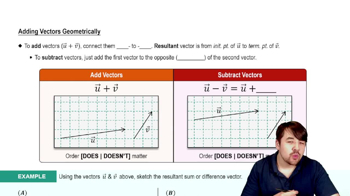
Vector Addition and Subtraction

Vector addition combines corresponding components of two vectors to form a new vector, while subtraction finds the difference between components. Understanding how to add and subtract vectors component-wise is essential for calculating expressions like u + v and u - v.
Recommended video:
05:29
Adding Vectors Geometrically

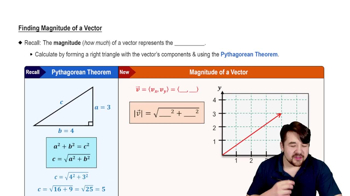
Vector Norm (Magnitude)

The norm or magnitude of a vector is the length of the vector in space, calculated as the square root of the sum of the squares of its components. For a vector a = xi + yj, ||a|| = √(x² + y²). Squared norms (||a||²) simplify calculations by avoiding the square root.
Recommended video:
04:44
Finding Magnitude of a Vector

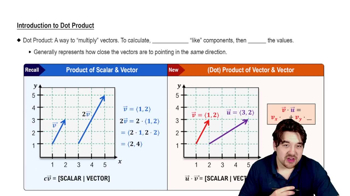
Properties of Dot Product and Norms

The dot product relates to vector magnitudes and angles, and satisfies the identity ||u + v||² = ||u||² + 2(u·v) + ||v||². Using this, the expression ||u + v||² - ||u - v||² simplifies to 4(u·v), linking vector norms and dot products for efficient computation.
Recommended video:
05:40
Introduction to Dot Product