Ch. 4 - Laws of Sines and Cosines; Vectors
Blitzer - Trigonometry 3rd Edition
Blitzer3rd EditionTrigonometryISBN: 9780137316601Not the one you use?Change textbook
Chapter 4, Problem 63

In Exercises 61–64, find the magnitude ||v||, to the nearest hundredth, and the direction angle θ, to the nearest tenth of a degree, for each given vector v. v = (4i - 2j) - (4i - 8j)

Verified step by step guidance
1
First, simplify the given vector expression by subtracting the components of the vectors: \(\mathbf{v} = (4\mathbf{i} - 2\mathbf{j}) - (4\mathbf{i} - 8\mathbf{j})\). This means subtract the \(i\) components and the \(j\) components separately.
Calculate the \(i\) component of \(\mathbf{v}\) by subtracting: \(4 - 4 = 0\). Calculate the \(j\) component of \(\mathbf{v}\) by subtracting: \(-2 - (-8) = -2 + 8 = 6\). So, \(\mathbf{v} = 0\mathbf{i} + 6\mathbf{j}\).
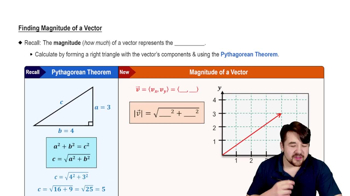
Find the magnitude \(||\mathbf{v}||\) using the formula for the magnitude of a vector: \(||\mathbf{v}|| = \sqrt{(v_x)^2 + (v_y)^2}\), where \(v_x\) and \(v_y\) are the components of \(\mathbf{v}\).
Substitute the components into the magnitude formula: \(||\mathbf{v}|| = \sqrt{0^2 + 6^2} = \sqrt{36}\). This will give the length of the vector.
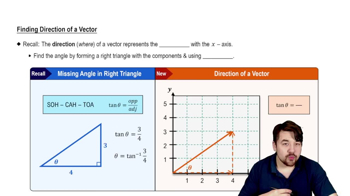
To find the direction angle \(\theta\), use the formula \(\theta = \tan^{-1}\left(\frac{v_y}{v_x}\right)\). Since \(v_x = 0\), consider the position of the vector on the coordinate plane to determine \(\theta\) correctly.

Verified video answer for a similar problem:

This video solution was recommended by our tutors as helpful for the problem above.
Video duration:
3m
Was this helpful?

Key Concepts

Here are the essential concepts you must grasp in order to answer the question correctly.

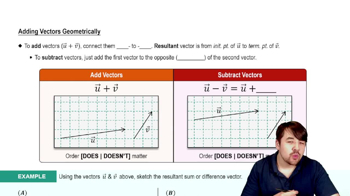
Vector Subtraction

Vector subtraction involves subtracting corresponding components of two vectors. For vectors in component form, subtract the i-components and j-components separately to find the resultant vector. This operation is essential to determine the vector v given by (4i - 2j) - (4i - 8j).
Recommended video:
05:29
Adding Vectors Geometrically

Magnitude of a Vector

The magnitude (or length) of a vector v = ai + bj is found using the Pythagorean theorem: ||v|| = √(a² + b²). This scalar value represents the distance from the origin to the point (a, b) in the plane and is crucial for quantifying the size of the vector.
Recommended video:
04:44
Finding Magnitude of a Vector

Direction Angle of a Vector

The direction angle θ of a vector is the angle it makes with the positive x-axis, measured counterclockwise. It can be found using θ = arctan(b/a), where a and b are the vector's components. Adjustments may be needed based on the quadrant to get the correct angle.
Recommended video:
05:13
Finding Direction of a Vector