Ch. 4 - Laws of Sines and Cosines; Vectors
Blitzer - Trigonometry 3rd Edition
Blitzer3rd EditionTrigonometryISBN: 9780137316601Not the one you use?Change textbook
Chapter 4, Problem 38

In Exercises 33–38, find the area of the triangle having the given measurements. Round to the nearest square unit. C = 102°, a = 16 meters, b = 20 meters

Verified step by step guidance
1
Identify the given elements of the triangle: angle \(C = 102^\circ\), side \(a = 16\) meters, and side \(b = 20\) meters. We need to find the area of the triangle.
Recall the formula for the area of a triangle when two sides and the included angle are known: \(\text{Area} = \frac{1}{2}ab \sin C\).
Substitute the known values into the formula: \(\text{Area} = \frac{1}{2} \times 16 \times 20 \times \sin 102^\circ\).
Calculate \(\sin 102^\circ\) using a calculator or trigonometric tables to find the sine of the given angle.
Multiply the values together to find the area, then round the result to the nearest whole number as requested.

Verified video answer for a similar problem:

This video solution was recommended by our tutors as helpful for the problem above.
Video duration:
2m
Was this helpful?

Key Concepts

Here are the essential concepts you must grasp in order to answer the question correctly.

Law of Cosines

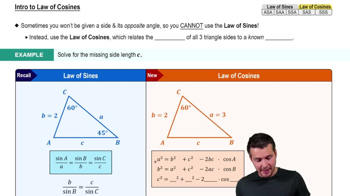
The Law of Cosines relates the lengths of the sides of a triangle to the cosine of one of its angles. It is useful for finding an unknown side or angle when two sides and the included angle are known, or vice versa. In this problem, it helps confirm the triangle's dimensions or find missing elements if needed.
Recommended video:
4:35
Intro to Law of Cosines

Area of a Triangle Using Two Sides and Included Angle

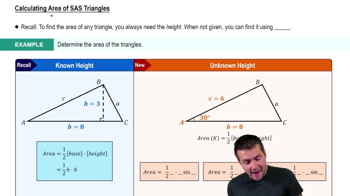
The area of a triangle can be calculated using the formula (1/2)ab sin(C), where a and b are two sides and C is the included angle. This formula is especially useful when the height is unknown but two sides and the included angle are given, as in this problem.
Recommended video:
4:02
Calculating Area of SAS Triangles

Trigonometric Functions and Angle Measurement

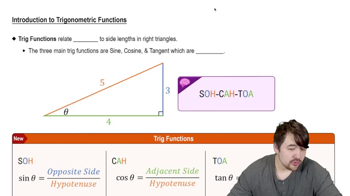
Understanding how to use trigonometric functions like sine and cosine with angles measured in degrees is essential. Correctly applying sin(102°) ensures accurate calculation of the area. Familiarity with converting and using angles in degrees is important for precise results.
Recommended video:
6:04
Introduction to Trigonometric Functions