In Exercises 33–38, find the area of the triangle having the given measurements. Round to the nearest square unit. C = 102°, a = 16 meters, b = 20 meters
Ch. 4 - Laws of Sines and Cosines; Vectors

Chapter 4, Problem 36
In Exercises 33–38, find the area of the triangle having the given measurements. Round to the nearest square unit.
B = 125°, a = 8 yards, c = 5 yards
Verified step by step guidance1
Identify the given elements of the triangle: angle \(B = 125^\circ\), side \(a = 8\) yards (opposite angle \(A\)), and side \(c = 5\) yards (opposite angle \(C\)).
Use the Law of Cosines to find the length of side \(b\) (opposite angle \(B\)) since you know two sides and the included angle \(B\). The Law of Cosines formula is:
\[b^2 = a^2 + c^2 - 2 \times a \times c \times \cos(B)\]
Calculate \(b\) by taking the square root of the result from the Law of Cosines:
\[b = \sqrt{a^2 + c^2 - 2ac \cos(B)}\]
Use the Law of Sines to find one of the other angles, for example angle \(A\), using the formula:
\[\frac{\sin(A)}{a} = \frac{\sin(B)}{b}\]
Rearranged to solve for \(\sin(A)\):
\[\sin(A) = \frac{a \times \sin(B)}{b}\]
Finally, find the area of the triangle using the formula involving two sides and the included angle:
\[\text{Area} = \frac{1}{2} \times a \times c \times \sin(B)\]
This formula directly uses the two known sides and the included angle to find the area.

Verified video answer for a similar problem:
This video solution was recommended by our tutors as helpful for the problem above.
Video duration:
2mWas this helpful?
Key Concepts
Here are the essential concepts you must grasp in order to answer the question correctly.
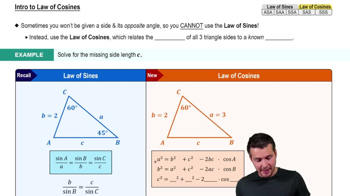
Law of Cosines
The Law of Cosines relates the lengths of sides of a triangle to the cosine of one of its angles. It is useful for finding an unknown side or angle when two sides and the included angle are known, or when all three sides are known. The formula is c² = a² + b² - 2ab cos(C).
Recommended video:
Intro to Law of Cosines
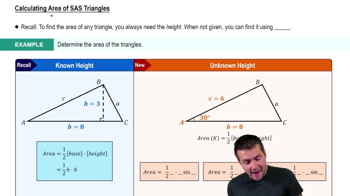
Area of a Triangle Using Two Sides and Included Angle
The area of a triangle can be found using the formula (1/2)ab sin(C), where a and b are two sides and C is the included angle between them. This method is especially useful when the height is not known but two sides and the included angle are given.
Recommended video:
Calculating Area of SAS Triangles
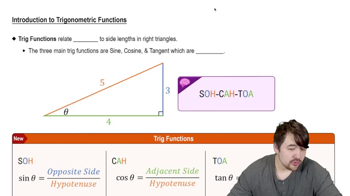
Trigonometric Functions and Angle Measurement
Understanding how to use sine and cosine functions with angles measured in degrees is essential. Angles in triangles are typically given in degrees, and trigonometric functions help relate these angles to side lengths, enabling calculation of unknown sides or areas.
Recommended video:
Introduction to Trigonometric Functions
Related Practice
Textbook Question
Textbook Question
In Exercises 35–36, the three given points are the vertices of a triangle. Solve each triangle, rounding lengths of sides to the nearest tenth and angle measures to the nearest degree.
A(0, 0), B(-3, 4), C(3, -1)
Textbook Question
If u = 5i + 2j, v = i - j, and w = 3i - 7j, find u ⋅ (v + w).
Textbook Question
In Exercises 33–38, find projᵥᵥ v. Then decompose v into two vectors, v₁ and v₂, where v₁ is parallel to w and v₂ is orthogonal to w.
v = i + 2j, w = 3i + 6j
Textbook Question
In Exercises 21–38, let u = 2i - 5j, v = -3i + 7j, and w = -i - 6j. Find each specified vector or scalar.
||w - u||
Textbook Question
In Exercises 33–38, find projᵥᵥ v. Then decompose v into two vectors, v₁ and v₂, where v₁ is parallel to w and v₂ is orthogonal to w.
v = i + 3j, w = -2i + 5j
1
views