Ch. 4 - Laws of Sines and Cosines; Vectors
Blitzer - Trigonometry 3rd Edition
Blitzer3rd EditionTrigonometryISBN: 9780137316601Not the one you use?Change textbook
Chapter 4, Problem 37

In Exercises 33–38, find projᵥᵥ v. Then decompose v into two vectors, v₁ and v₂, where v₁ is parallel to w and v₂ is orthogonal to w.
v = i + 2j, w = 3i + 6j

Verified step by step guidance
1
Identify the vectors given: \( \mathbf{v} = \mathbf{i} + 2\mathbf{j} \) and \( \mathbf{w} = 3\mathbf{i} + 6\mathbf{j} \). Express them in component form as \( \mathbf{v} = (1, 2) \) and \( \mathbf{w} = (3, 6) \).
Recall the formula for the projection of \( \mathbf{v} \) onto \( \mathbf{w} \): \[ \text{proj}_{\mathbf{w}} \mathbf{v} = \left( \frac{\mathbf{v} \cdot \mathbf{w}}{\mathbf{w} \cdot \mathbf{w}} \right) \mathbf{w} \] where \( \mathbf{v} \cdot \mathbf{w} \) is the dot product of \( \mathbf{v} \) and \( \mathbf{w} \).
Calculate the dot products: \[ \mathbf{v} \cdot \mathbf{w} = (1)(3) + (2)(6) = 3 + 12 \] and \[ \mathbf{w} \cdot \mathbf{w} = (3)^2 + (6)^2 = 9 + 36 \]
Substitute the dot products into the projection formula to find \( \text{proj}_{\mathbf{w}} \mathbf{v} \). This gives the vector \( \mathbf{v}_1 \) which is parallel to \( \mathbf{w} \).
Find the vector \( \mathbf{v}_2 \) which is orthogonal to \( \mathbf{w} \) by subtracting the projection from \( \mathbf{v} \): \[ \mathbf{v}_2 = \mathbf{v} - \mathbf{v}_1 \] This completes the decomposition of \( \mathbf{v} \) into \( \mathbf{v}_1 \) (parallel to \( \mathbf{w} \)) and \( \mathbf{v}_2 \) (orthogonal to \( \mathbf{w} \)).

Verified video answer for a similar problem:

This video solution was recommended by our tutors as helpful for the problem above.
Video duration:
6m
Was this helpful?

Key Concepts

Here are the essential concepts you must grasp in order to answer the question correctly.

Vector Projection

Vector projection of v onto w, denoted proj_w v, is the component of v that points in the direction of w. It is calculated using the formula proj_w v = [(v · w) / (w · w)] * w, where '·' denotes the dot product. This concept helps in finding how much of one vector lies along another.
Recommended video:
03:48
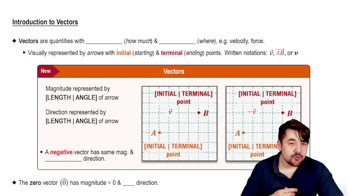
Introduction to Vectors

Dot Product of Vectors

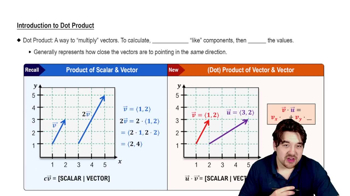
The dot product is an algebraic operation that takes two vectors and returns a scalar. It is computed as v · w = v₁w₁ + v₂w₂ for 2D vectors. The dot product is essential for finding projections and determining angles between vectors.
Recommended video:
05:40
Introduction to Dot Product

Vector Decomposition into Parallel and Orthogonal Components

Any vector v can be decomposed into two components: v₁ parallel to w and v₂ orthogonal to w. Here, v₁ = proj_w v, and v₂ = v - v₁. This decomposition is useful in many applications, such as resolving forces or simplifying vector problems.
Recommended video:
03:55
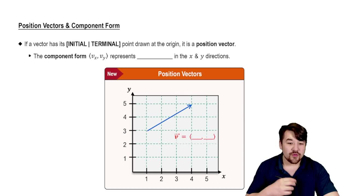
Position Vectors & Component Form