Ch. 4 - Laws of Sines and Cosines; Vectors
Blitzer - Trigonometry 3rd Edition
Blitzer3rd EditionTrigonometryISBN: 9780137316601Not the one you use?Change textbook
Chapter 4, Problem 38

In Exercises 37–39, find the dot product v ⋅ w. Then find the angle between v and w to the nearest tenth of a degree.
v = 2i + 4j, w = 6i - 11j

Verified step by step guidance
1
Identify the components of the vectors \( \mathbf{v} = 2\mathbf{i} + 4\mathbf{j} \) and \( \mathbf{w} = 6\mathbf{i} - 11\mathbf{j} \). Here, \( \mathbf{v} = (2, 4) \) and \( \mathbf{w} = (6, -11) \).
Calculate the dot product \( \mathbf{v} \cdot \mathbf{w} \) using the formula \( \mathbf{v} \cdot \mathbf{w} = v_1 w_1 + v_2 w_2 \). Substitute the components to get \( 2 \times 6 + 4 \times (-11) \).
Find the magnitudes of \( \mathbf{v} \) and \( \mathbf{w} \) using the formula \( \|\mathbf{v}\| = \sqrt{v_1^2 + v_2^2} \) and similarly for \( \mathbf{w} \). Calculate \( \|\mathbf{v}\| = \sqrt{2^2 + 4^2} \) and \( \|\mathbf{w}\| = \sqrt{6^2 + (-11)^2} \).
Use the dot product and magnitudes to find the cosine of the angle \( \theta \) between the vectors with the formula \( \cos(\theta) = \frac{\mathbf{v} \cdot \mathbf{w}}{\|\mathbf{v}\| \|\mathbf{w}\|} \).
Finally, find the angle \( \theta \) by taking the inverse cosine (arccos) of the value found in the previous step, and convert the result to degrees if necessary, rounding to the nearest tenth of a degree.

Verified video answer for a similar problem:

This video solution was recommended by our tutors as helpful for the problem above.
Video duration:
5m
Was this helpful?

Key Concepts

Here are the essential concepts you must grasp in order to answer the question correctly.

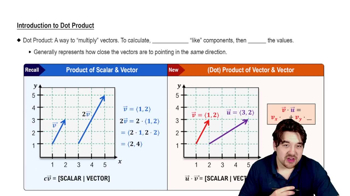
Dot Product of Two Vectors

The dot product is an algebraic operation that takes two vectors and returns a scalar. It is calculated by multiplying corresponding components and summing the results, e.g., for vectors v = (v1, v2) and w = (w1, w2), v ⋅ w = v1w1 + v2w2. This operation measures how much one vector extends in the direction of another.
Recommended video:
05:40
Introduction to Dot Product

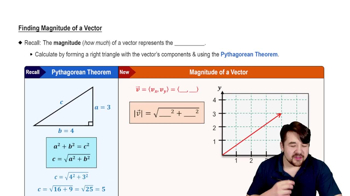
Magnitude of a Vector

The magnitude (or length) of a vector is the distance from the origin to the point represented by the vector. For a vector v = (v1, v2), its magnitude is |v| = √(v1² + v2²). Magnitudes are essential for normalizing vectors and calculating angles between them.
Recommended video:
04:44
Finding Magnitude of a Vector

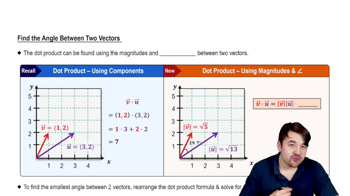
Angle Between Two Vectors

The angle θ between two vectors v and w can be found using the dot product formula: v ⋅ w = |v||w|cos(θ). Rearranging gives θ = cos⁻¹((v ⋅ w) / (|v||w|)). This formula relates the dot product and magnitudes to the cosine of the angle, allowing calculation of the angle in degrees or radians.
Recommended video:
04:33
Find the Angle Between Vectors