Ch. 6 - Normal Probability Distributions
Triola - Elementary Statistics 14th Edition
Triola14th EditionElementary StatisticsISBN: 9780137366446Not the one you use?Change textbook
Chapter 6, Problem 6.3.10c

In Exercises 7–10, use the same population of {4, 5, 9} that was used in Examples 2 and 5. As in Examples 2 and 5, assume that samples of size n = 2 are randomly selected with replacement.


Sampling Distribution of the Sample Proportion


c. Find the mean of the sampling distribution of the sample proportion of odd numbers.

Verified step by step guidance
1
Step 1: Identify the population and the parameter of interest. The population is {4, 5, 9}, and we are interested in the proportion of odd numbers in the samples. Odd numbers in the population are {5, 9}.
Step 2: Determine the sample size (n = 2) and note that sampling is done with replacement. This means each sample can include repeated values from the population.
Step 3: List all possible samples of size 2 that can be drawn with replacement from the population. For example, the samples are {(4, 4), (4, 5), (4, 9), (5, 4), (5, 5), (5, 9), (9, 4), (9, 5), (9, 9)}.
Step 4: For each sample, calculate the sample proportion of odd numbers. For example, in the sample (4, 5), the proportion of odd numbers is 1/2 because only one of the two numbers is odd.
Step 5: Compute the mean of the sampling distribution of the sample proportion by averaging all the sample proportions calculated in Step 4. Use the formula: μ=ΣpN, where Σp is the sum of all sample proportions and N is the total number of samples.

Verified video answer for a similar problem:

This video solution was recommended by our tutors as helpful for the problem above.
Video duration:
6m
Was this helpful?

Key Concepts

Here are the essential concepts you must grasp in order to answer the question correctly.

Sampling Distribution

A sampling distribution is the probability distribution of a statistic obtained from a larger population, created by taking multiple samples. In this context, it refers to the distribution of the sample proportion of odd numbers when samples of size n = 2 are drawn from the population {4, 5, 9}. Understanding this concept is crucial for analyzing how sample statistics behave and vary from the population parameter.
Recommended video:
05:11
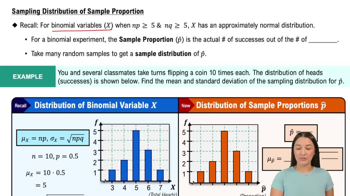
Sampling Distribution of Sample Proportion

Sample Proportion

The sample proportion is the ratio of the number of successes (in this case, odd numbers) to the total number of observations in the sample. For the population {4, 5, 9}, the odd numbers are 5 and 9. The sample proportion helps in estimating the likelihood of finding odd numbers in random samples, which is essential for calculating the mean of the sampling distribution.
Recommended video:
05:11
Sampling Distribution of Sample Proportion

Mean of the Sampling Distribution

The mean of the sampling distribution of a sample proportion is the expected value of that proportion across all possible samples. It can be calculated as the population proportion of odd numbers. This mean provides insight into the central tendency of the sample proportions, allowing for predictions about the behavior of samples drawn from the population.
Recommended video:
05:11
Sampling Distribution of Sample Proportion
Related Practice
Textbook Question

In Exercises 1 and 2, use the following wait times (minutes) at 10:00 AM for the Tower of Terror ride at Disney World (from Data Set 33 “Disney World Wait Times” in Appendix B).


35 35 20 50 95 75 45 50 30 35 30 30


c. Find the standard deviation s.

Textbook Question

In Exercises 1 and 2, use the following wait times (minutes) at 10:00 AM for the Tower of Terror ride at Disney World (from Data Set 33 “Disney World Wait Times” in Appendix B).


35 35 20 50 95 75 45 50 30 35 30 30


g. What level of measurement (nominal, ordinal, interval, ratio) describes this data set?

6
views
Textbook Question

Curving Test Scores A professor gives a test and the scores are normally distributed with a mean of 60 and a standard deviation of 12. She plans to curve the scores.


c. If the grades are curved so that grades of B are given to scores above the bottom 70% and below the top 10%, find the numerical limits for a grade of B.

Textbook Question

In Exercises 7–10, use the same population of {4, 5, 9} that was used in Examples 2 and 5. As in Examples 2 and 5, assume that samples of size n = 2 are randomly selected with replacement.


c. Find the mean of the sampling distribution of the sample variance.

1
views
Textbook Question

Hybridization A hybridization experiment begins with four peas having yellow pods and one pea having a green pod. Two of the peas are randomly selected with replacement from this population.


c. Is the mean of the sampling distribution [from part (b)] equal to the population proportion of peas with yellow pods? Does the mean of the sampling distribution of proportions always equal the population proportion?

Textbook Question

Hybridization A hybridization experiment begins with four peas having yellow pods and one pea having a green pod. Two of the peas are randomly selected with replacement from this population.


b. Find the mean of the sampling distribution.