Ch. 6 - Normal Probability Distributions
Triola - Elementary Statistics 14th Edition
Triola14th EditionElementary StatisticsISBN: 9780137366446Not the one you use?Change textbook
Chapter 6, Problem 6.c.1c

In Exercises 1 and 2, use the following wait times (minutes) at 10:00 AM for the Tower of Terror ride at Disney World (from Data Set 33 “Disney World Wait Times” in Appendix B).


35 35 20 50 95 75 45 50 30 35 30 30


c. Find the standard deviation s.

Verified step by step guidance
1
Step 1: Calculate the mean (average) of the data set. Add all the wait times together and divide by the total number of data points. Use the formula: μ = xin, where n is the number of data points.
Step 2: Subtract the mean from each data point to find the deviation of each value from the mean. For each data point xi, compute xi - μ.
Step 3: Square each deviation to eliminate negative values. For each deviation, compute (xi - μ)2.
Step 4: Find the variance by calculating the average of the squared deviations. Use the formula: σ2 = (xi - μ)2n.
Step 5: Take the square root of the variance to find the standard deviation. Use the formula: s = σ2.

Verified video answer for a similar problem:

This video solution was recommended by our tutors as helpful for the problem above.
Video duration:
3m
Was this helpful?

Key Concepts

Here are the essential concepts you must grasp in order to answer the question correctly.

Standard Deviation

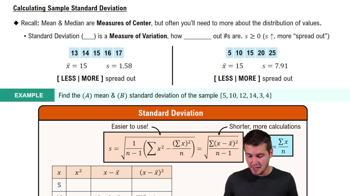
Standard deviation is a statistical measure that quantifies the amount of variation or dispersion in a set of data values. A low standard deviation indicates that the values tend to be close to the mean, while a high standard deviation indicates that the values are spread out over a wider range. It is calculated as the square root of the variance, which is the average of the squared differences from the mean.
Recommended video:
Guided course
08:45
Calculating Standard Deviation

Mean

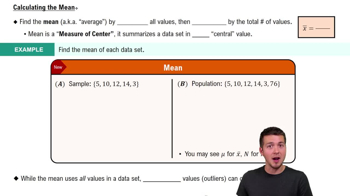
The mean, often referred to as the average, is calculated by summing all the data points and dividing by the number of points. It provides a central value for the data set and is essential for calculating the standard deviation. Understanding the mean helps in interpreting how individual data points relate to the overall dataset.
Recommended video:
Guided course
04:52
Calculating the Mean

Variance

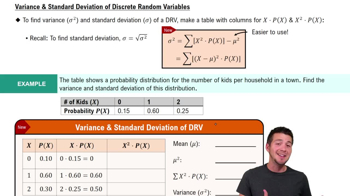
Variance is a measure of how much the values in a data set differ from the mean. It is calculated by taking the average of the squared differences between each data point and the mean. Variance is a key component in determining the standard deviation, as it provides insight into the spread of the data, which is crucial for understanding the reliability and consistency of the data set.
Recommended video:
Guided course
04:48
Variance & Standard Deviation of Discrete Random Variables
Related Practice
Textbook Question

Eye Color Based on a study by Dr. P. Sorita at Indiana University, assume that 12% of us have green eyes. In a study of 650 people, it is found that 86 of them have green eyes.


b. Is 86 people with green eyes significantly high?
Textbook Question

In Exercises 25–28, use these parameters (based on Data Set 1 “Body Data” in Appendix B):

Men’s heights are normally distributed with mean 68.6 in. and standard deviation 2.8 in.

Women’s heights are normally distributed with mean 63.7 in. and standard deviation 2.9 in.

If the Navy changes the height requirements so that all women are eligible except the shortest 3% and the tallest 3%, what are the new height requirements for women?

Textbook Question

Curving Test Scores A professor gives a test and the scores are normally distributed with a mean of 60 and a standard deviation of 12. She plans to curve the scores.


c. If the grades are curved so that grades of B are given to scores above the bottom 70% and below the top 10%, find the numerical limits for a grade of B.

Textbook Question

In Exercises 7–10, use the same population of {4, 5, 9} that was used in Examples 2 and 5. As in Examples 2 and 5, assume that samples of size n = 2 are randomly selected with replacement.


Sampling Distribution of the Sample Proportion


c. Find the mean of the sampling distribution of the sample proportion of odd numbers.

Textbook Question

Hybridization A hybridization experiment begins with four peas having yellow pods and one pea having a green pod. Two of the peas are randomly selected with replacement from this population.


c. Is the mean of the sampling distribution [from part (b)] equal to the population proportion of peas with yellow pods? Does the mean of the sampling distribution of proportions always equal the population proportion?

Textbook Question

Hybridization A hybridization experiment begins with four peas having yellow pods and one pea having a green pod. Two of the peas are randomly selected with replacement from this population.


b. Find the mean of the sampling distribution.