Ch. 6 - Normal Probability Distributions
Triola - Elementary Statistics 14th Edition
Triola14th EditionElementary StatisticsISBN: 9780137366446Not the one you use?Change textbook
Chapter 6, Problem 6.3.18b

Hybridization A hybridization experiment begins with four peas having yellow pods and one pea having a green pod. Two of the peas are randomly selected with replacement from this population.


b. Find the mean of the sampling distribution.

Verified step by step guidance
1
Step 1: Understand the problem. The population consists of 4 yellow pod peas and 1 green pod pea. Since the selection is with replacement, the probability of selecting a yellow pod pea (P(Y)) is 4/5, and the probability of selecting a green pod pea (P(G)) is 1/5. The random variable X represents the number of green pod peas selected in two trials.
Step 2: Recognize that the random variable X follows a binomial distribution because there are a fixed number of trials (n = 2), each trial is independent, and there are only two outcomes (green or yellow). The probability of success (selecting a green pod pea) is p = 1/5.
Step 3: Recall the formula for the mean (expected value) of a binomial distribution: E(X) = n * p, where n is the number of trials and p is the probability of success.
Step 4: Substitute the values into the formula. Here, n = 2 (two selections) and p = 1/5 (probability of selecting a green pod pea). The formula becomes E(X) = 2 * (1/5).
Step 5: Simplify the expression to find the mean of the sampling distribution. The result will represent the expected number of green pod peas selected in two trials.

Verified video answer for a similar problem:

This video solution was recommended by our tutors as helpful for the problem above.
Video duration:
5m
Was this helpful?

Key Concepts

Here are the essential concepts you must grasp in order to answer the question correctly.

Sampling Distribution

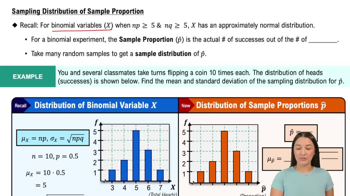
A sampling distribution is the probability distribution of a statistic obtained by selecting random samples from a population. In this context, it refers to the distribution of the means of samples drawn from the population of peas with yellow and green pods. Understanding this concept is crucial for calculating the mean of the sampling distribution.
Recommended video:
05:11
Sampling Distribution of Sample Proportion

Mean

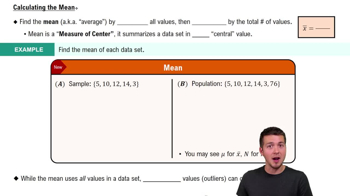
The mean, or average, is a measure of central tendency that summarizes a set of values by dividing the sum of those values by the number of values. In the context of the sampling distribution, the mean represents the expected value of the sample means, which can be calculated based on the population proportions of yellow and green pods.
Recommended video:
Guided course
04:52
Calculating the Mean

Random Sampling with Replacement

Random sampling with replacement means that each selected item is returned to the population before the next selection, allowing for the same item to be chosen multiple times. This method affects the probabilities of outcomes and is essential for determining the characteristics of the sampling distribution, including its mean.
Recommended video:
05:11
Sampling Distribution of Sample Proportion
Related Practice
Textbook Question

Eye Color Based on a study by Dr. P. Sorita at Indiana University, assume that 12% of us have green eyes. In a study of 650 people, it is found that 86 of them have green eyes.


b. Is 86 people with green eyes significantly high?
Textbook Question

In Exercises 1 and 2, use the following wait times (minutes) at 10:00 AM for the Tower of Terror ride at Disney World (from Data Set 33 “Disney World Wait Times” in Appendix B).


35 35 20 50 95 75 45 50 30 35 30 30


c. Find the standard deviation s.

Textbook Question

In Exercises 25–28, use these parameters (based on Data Set 1 “Body Data” in Appendix B):

Men’s heights are normally distributed with mean 68.6 in. and standard deviation 2.8 in.

Women’s heights are normally distributed with mean 63.7 in. and standard deviation 2.9 in.

If the Navy changes the height requirements so that all women are eligible except the shortest 3% and the tallest 3%, what are the new height requirements for women?

Textbook Question

In Exercises 7–10, use the same population of {4, 5, 9} that was used in Examples 2 and 5. As in Examples 2 and 5, assume that samples of size n = 2 are randomly selected with replacement.


Sampling Distribution of the Sample Proportion


c. Find the mean of the sampling distribution of the sample proportion of odd numbers.

Textbook Question

Hybridization A hybridization experiment begins with four peas having yellow pods and one pea having a green pod. Two of the peas are randomly selected with replacement from this population.


c. Is the mean of the sampling distribution [from part (b)] equal to the population proportion of peas with yellow pods? Does the mean of the sampling distribution of proportions always equal the population proportion?

Textbook Question

Transformations The heights (in inches) of women listed in Data Set 1 “Body Data” in Appendix B have a distribution that is approximately normal, so it appears that those heights are from a normally distributed population.


b. If each height is converted from inches to centimeters, are the heights in centimeters also normally distributed?