Ch. 6 - Normal Probability Distributions
Triola - Elementary Statistics 14th Edition
Triola14th EditionElementary StatisticsISBN: 9780137366446Not the one you use?Change textbook
Chapter 6, Problem 6.c.1g

In Exercises 1 and 2, use the following wait times (minutes) at 10:00 AM for the Tower of Terror ride at Disney World (from Data Set 33 “Disney World Wait Times” in Appendix B).


35 35 20 50 95 75 45 50 30 35 30 30


g. What level of measurement (nominal, ordinal, interval, ratio) describes this data set?

Verified step by step guidance
1
Step 1: Understand the concept of levels of measurement. There are four levels: nominal, ordinal, interval, and ratio. Each level describes how data is categorized and the mathematical operations that can be performed on it.
Step 2: Analyze the data provided. The wait times are numerical values (e.g., 35, 35, 20, etc.), which represent the amount of time in minutes that visitors waited for the ride.
Step 3: Determine if the data has a true zero point. Since wait times can be zero (indicating no wait), this data has a true zero point, which is a key characteristic of ratio-level measurement.
Step 4: Check if the data allows for meaningful comparisons using ratios. For example, a wait time of 50 minutes is twice as long as a wait time of 25 minutes. This confirms that the data is at the ratio level.
Step 5: Conclude that the level of measurement for this data set is 'ratio' because it is numerical, has a true zero point, and allows for meaningful ratio comparisons.

Verified video answer for a similar problem:

This video solution was recommended by our tutors as helpful for the problem above.
Video duration:
2m
Was this helpful?

Key Concepts

Here are the essential concepts you must grasp in order to answer the question correctly.

Levels of Measurement

Levels of measurement refer to the different ways data can be categorized and analyzed. There are four primary levels: nominal, ordinal, interval, and ratio. Nominal data are categories without a specific order, ordinal data have a defined order but no consistent difference between values, interval data have meaningful differences but no true zero, and ratio data have all the properties of interval data with a true zero point.
Recommended video:
Guided course
10:28
Difference in Proportions: Hypothesis Tests Example 1

Ratio Level of Measurement

The ratio level of measurement is the highest level of measurement, which includes all the properties of interval data, along with a true zero point that allows for the comparison of absolute magnitudes. In this level, both differences and ratios are meaningful. For example, a wait time of 0 minutes indicates no wait, and a wait time of 40 minutes is twice as long as a wait time of 20 minutes.
Recommended video:
Guided course
10:28
Difference in Proportions: Hypothesis Tests Example 1

Data Set Characteristics

Understanding the characteristics of a data set is crucial for determining its level of measurement. In this case, the wait times are numerical values representing time, which can be compared and measured. This numerical nature, along with the presence of a true zero (no wait time), indicates that the data set is best described as a ratio level of measurement.
Recommended video:
Guided course
04:39
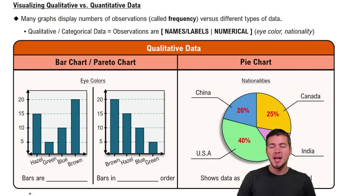
Visualizing Qualitative vs. Quantitative Data
Related Practice
Textbook Question

In Exercises 1 and 2, use the following wait times (minutes) at 10:00 AM for the Tower of Terror ride at Disney World (from Data Set 33 “Disney World Wait Times” in Appendix B).


35 35 20 50 95 75 45 50 30 35 30 30


Tower of Terror Wait Times


a. Find Q1, Q2 and Q3.

1
views
Textbook Question

In Exercises 1 and 2, use the following wait times (minutes) at 10:00 AM for the Tower of Terror ride at Disney World (from Data Set 33 “Disney World Wait Times” in Appendix B).


35 35 20 50 95 75 45 50 30 35 30 30


d. Find the variance.

Textbook Question

Curving Test Scores A professor gives a test and the scores are normally distributed with a mean of 60 and a standard deviation of 12. She plans to curve the scores.


c. If the grades are curved so that grades of B are given to scores above the bottom 70% and below the top 10%, find the numerical limits for a grade of B.

Textbook Question

In Exercises 7–10, use the same population of {4, 5, 9} that was used in Examples 2 and 5. As in Examples 2 and 5, assume that samples of size n = 2 are randomly selected with replacement.


c. Find the mean of the sampling distribution of the sample variance.

1
views
Textbook Question

Ergonomics. Exercises 9–16 involve applications to ergonomics, as described in the Chapter Problem.


Safe Loading of Elevators The elevator in the car rental building at San Francisco International Airport has a placard stating that the maximum capacity is “4000 lb—27 passengers.” Because 4000/27=148, this converts to a mean passenger weight of 148 lb when the elevator is full. We will assume a worst-case scenario in which the elevator is filled with 27 adult males. Based on Data Set 1 “Body Data” in Appendix B, assume that adult males have weights that are normally distributed with a mean of 189 lb and a standard deviation of 39 lb.


c. What do you conclude about the safety of this elevator?

Textbook Question

In Exercises 7–10, use the same population of {4, 5, 9} that was used in Examples 2 and 5. As in Examples 2 and 5, assume that samples of size n = 2 are randomly selected with replacement.


Sampling Distribution of the Sample Proportion


c. Find the mean of the sampling distribution of the sample proportion of odd numbers.