Graphical Analysis In Exercises 11–14, determine whether there is a perfect positive linear correlation, a strong positive linear correlation, a perfect negative linear correlation, a strong negative linear correlation, or no linear correlation between the variables.
Ch. 9 - Correlation and Regression
Larson8th EditionElementary Statistics: Picturing the WorldISBN: 9780137493470Not the one you use?Change textbook
Chapter 9, Problem 9.1.29
In Exercise 23, add data for a child who is 6 years old and has a vocabulary of 900 words. Describe how this affects the correlation coefficient r.
Verified step by step guidance1
Step 1: Understand the correlation coefficient (r). The correlation coefficient measures the strength and direction of the linear relationship between two variables. It ranges from -1 to 1, where values close to 1 or -1 indicate strong relationships, and values near 0 indicate weak or no linear relationship.
Step 2: Identify the existing dataset and the variables involved. In this case, the variables are the age of the child and their vocabulary size. The new data point to be added is (6 years, 900 words).
Step 3: Consider how the new data point fits into the existing trend. If the new data point aligns well with the existing linear relationship, it will strengthen the correlation coefficient. If it deviates significantly from the trend, it may weaken the correlation coefficient.
Step 4: Recalculate the correlation coefficient after adding the new data point. Use the formula for the correlation coefficient: . This involves recalculating the mean and standard deviation for both variables and determining the covariance.
Step 5: Analyze the impact of the new data point on the correlation coefficient. Compare the recalculated value of r with the original value. If the new data point is consistent with the existing trend, r will likely increase or remain stable. If it deviates, r may decrease.

Verified video answer for a similar problem:
This video solution was recommended by our tutors as helpful for the problem above.
Video duration:
4mWas this helpful?
Key Concepts
Here are the essential concepts you must grasp in order to answer the question correctly.
Correlation Coefficient (r)
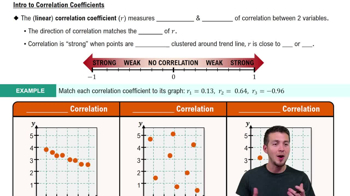
The correlation coefficient, denoted as r, measures the strength and direction of a linear relationship between two variables. It ranges from -1 to 1, where 1 indicates a perfect positive correlation, -1 a perfect negative correlation, and 0 no correlation. Understanding how to interpret r is crucial for analyzing relationships in data.
Recommended video:
Guided course
Correlation Coefficient
Impact of Outliers
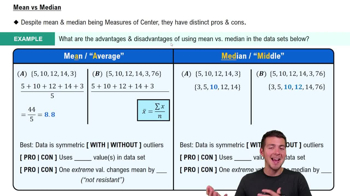
Outliers are data points that differ significantly from other observations. They can heavily influence statistical measures, including the correlation coefficient. In this context, adding a data point for a 6-year-old with a vocabulary of 900 words may act as an outlier, potentially skewing the correlation and altering the perceived relationship between age and vocabulary.
Recommended video:
Guided course
Comparing Mean vs. Median
Linear Relationship
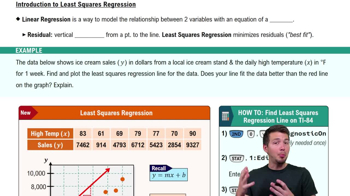
A linear relationship between two variables implies that as one variable changes, the other variable changes in a consistent manner. This relationship can be positive, negative, or nonexistent. Recognizing whether the data exhibits a linear pattern is essential for accurately calculating and interpreting the correlation coefficient.
Recommended video:
Guided course
Intro to Least Squares Regression
Related Practice
Textbook Question
1
views
Textbook Question
6. Discuss the difference between r and p.
Textbook Question
5. To predict y-values using the equation of a regression line, what must be true about the correlation coefficient of the variables?
Textbook Question
2. Compare the numbers of dependent and independent variables in a multiple regression equation and a single regression equation.
Textbook Question
What is the coefficient of determination for two variables that have perfect positive linear correlation or perfect negative linear correlation? Interpret your answer.
Textbook Question
The coefficient of determination r^2 is the ratio of which two types of variations? What does r^2 measure? What does 1 - r^2 measure?
