
Graphical Analysis In Exercises 11–14, determine whether there is a perfect positive linear correlation, a strong positive linear correlation, a perfect negative linear correlation, a strong negative linear correlation, or no linear correlation between the variables.
Ch. 9 - Correlation and Regression
Larson8th EditionElementary Statistics: Picturing the WorldISBN: 9780137493470Not the one you use?Change textbook
Chapter 9, Problem 9.4.2
2. Compare the numbers of dependent and independent variables in a multiple regression equation and a single regression equation.
Verified step by step guidance1
Step 1: Understand the definitions of dependent and independent variables. The dependent variable is the outcome or response variable that the model aims to predict or explain. Independent variables are the predictors or explanatory variables used to explain variations in the dependent variable.
Step 2: In a single regression equation, there is exactly one dependent variable and one independent variable. The general form is: , where is the dependent variable and is the single independent variable.
Step 3: In a multiple regression equation, there is still one dependent variable, but there are two or more independent variables. The general form is: , where is the dependent variable and are the independent variables.
Step 4: Compare the two: both types of regression have one dependent variable, but the number of independent variables differs—single regression has one, multiple regression has two or more.
Step 5: Summarize that the key difference lies in the number of independent variables used to explain the dependent variable, which affects the complexity and explanatory power of the regression model.

Verified video answer for a similar problem:
This video solution was recommended by our tutors as helpful for the problem above.
Video duration:
1mWas this helpful?
Key Concepts
Here are the essential concepts you must grasp in order to answer the question correctly.
Dependent Variable
The dependent variable is the outcome or response variable that the model aims to predict or explain. In both single and multiple regression, there is only one dependent variable, which depends on one or more independent variables.
Recommended video:
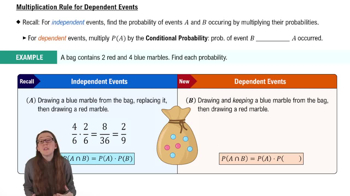
Multiplication Rule: Dependent Events
Independent Variables
Independent variables, also called predictors or explanatory variables, are the factors used to explain changes in the dependent variable. A single regression uses one independent variable, while multiple regression involves two or more independent variables.
Recommended video:
Guided course
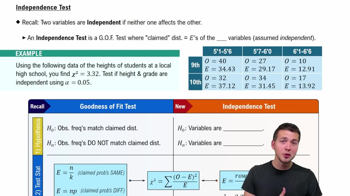
Independence Test
Regression Equation Structure
A regression equation expresses the dependent variable as a function of independent variables and coefficients. In single regression, the equation has one predictor (e.g., Y = b0 + b1X), whereas multiple regression includes multiple predictors (e.g., Y = b0 + b1X1 + b2X2 + ... + bnXn).
Recommended video:
Guided course
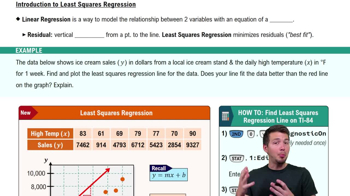
Intro to Least Squares Regression
Related Practice
Textbook Question
1
views
Textbook Question
6. Discuss the difference between r and p.
Textbook Question
In Exercise 23, add data for a child who is 6 years old and has a vocabulary of 900 words. Describe how this affects the correlation coefficient r.
Textbook Question
What is the coefficient of determination for two variables that have perfect positive linear correlation or perfect negative linear correlation? Interpret your answer.
Textbook Question
The coefficient of determination r^2 is the ratio of which two types of variations? What does r^2 measure? What does 1 - r^2 measure?
Textbook Question
6. Why is it not appropriate to use a regression line to predict y-values for x-values that are not in (or close to) the range of x-values found in the data?
