
Graphical Analysis In Exercises 11–14, determine whether there is a perfect positive linear correlation, a strong positive linear correlation, a perfect negative linear correlation, a strong negative linear correlation, or no linear correlation between the variables.
Ch. 9 - Correlation and Regression
Larson8th EditionElementary Statistics: Picturing the WorldISBN: 9780137493470Not the one you use?Change textbook
Chapter 9, Problem 9.1.6
6. Discuss the difference between r and p.
Verified step by step guidance1
Understand that 'r' refers to the sample correlation coefficient, which measures the strength and direction of a linear relationship between two variables in a sample. It ranges from -1 to 1.
Recognize that 'p' refers to the population correlation coefficient, which measures the strength and direction of a linear relationship between two variables in the entire population. It also ranges from -1 to 1.
Note that 'r' is calculated from sample data and serves as an estimate of 'p'. Since it is based on a sample, 'r' is subject to sampling variability and may not perfectly represent 'p'.
Understand that 'p' is a theoretical value that represents the true correlation in the population. It is often unknown and must be inferred using statistical methods.
Discuss the importance of hypothesis testing in determining whether 'r' provides sufficient evidence to conclude that 'p' is significantly different from zero, indicating a meaningful relationship in the population.

Verified video answer for a similar problem:
This video solution was recommended by our tutors as helpful for the problem above.
Video duration:
2mWas this helpful?
Key Concepts
Here are the essential concepts you must grasp in order to answer the question correctly.
Correlation Coefficient (r)
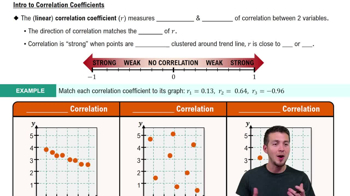
The correlation coefficient, denoted as 'r', measures the strength and direction of a linear relationship between two variables. Its value ranges from -1 to 1, where 1 indicates a perfect positive correlation, -1 indicates a perfect negative correlation, and 0 indicates no correlation. Understanding 'r' is crucial for interpreting how closely two variables move together.
Recommended video:
Guided course
Correlation Coefficient
p-value
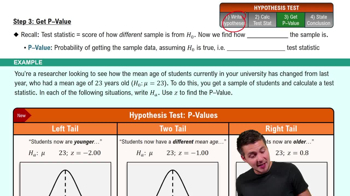
The p-value is a statistical measure that helps determine the significance of results in hypothesis testing. It indicates the probability of observing the data, or something more extreme, assuming the null hypothesis is true. A low p-value (typically < 0.05) suggests that the observed effect is unlikely to have occurred by chance, leading to the rejection of the null hypothesis.
Recommended video:
Guided course
Step 3: Get P-Value
Statistical Significance
Statistical significance refers to the likelihood that a relationship or effect observed in data is not due to random chance. It is often assessed using the p-value, where a result is considered statistically significant if the p-value is below a predetermined threshold (commonly 0.05). This concept is essential for validating findings in research and ensuring that conclusions drawn from data are reliable.
Recommended video:
Guided course
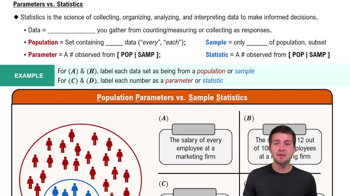
Parameters vs. Statistics
Related Practice
Textbook Question
1
views
Textbook Question
"Old Vehicles In Exercises 31–34, use the figure shown at the left.
33. Coefficient of Determination Find the coefficient of determination r^2 and interpret the results."
Textbook Question
5. To predict y-values using the equation of a regression line, what must be true about the correlation coefficient of the variables?
Textbook Question
2. Describe the range of values for the correlation coefficient.
Textbook Question
In Exercise 23, add data for a child who is 6 years old and has a vocabulary of 900 words. Describe how this affects the correlation coefficient r.
Textbook Question
2. Compare the numbers of dependent and independent variables in a multiple regression equation and a single regression equation.
