Ch. 9 - Correlation and Regression
Larson - Elementary Statistics: Picturing the World 8th Edition
Larson8th EditionElementary Statistics: Picturing the WorldISBN: 9780137493470Not the one you use?Change textbook
Chapter 9, Problem 9.1.14

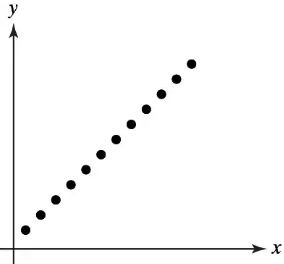
Graphical Analysis In Exercises 11–14, determine whether there is a perfect positive linear correlation, a strong positive linear correlation, a perfect negative linear correlation, a strong negative linear correlation, or no linear correlation between the variables.
Scatterplot showing a perfect positive linear correlation with points closely aligned along an upward sloping line.

Verified step by step guidance
1
Step 1: Observe the scatterplot provided in the image. The points are closely aligned along a straight line that slopes upward from left to right.
Step 2: Recall the definition of correlation. A perfect positive linear correlation occurs when all data points lie exactly on a straight line with a positive slope, indicating a direct proportional relationship between the variables.
Step 3: Compare the alignment of the points in the scatterplot to the characteristics of a perfect positive linear correlation. Since the points are perfectly aligned along the upward-sloping line, this matches the definition of a perfect positive linear correlation.
Step 4: Note that there is no deviation of the points from the line, which confirms the relationship is perfect and positive.
Step 5: Conclude that the scatterplot demonstrates a perfect positive linear correlation between the variables.

Verified video answer for a similar problem:

This video solution was recommended by our tutors as helpful for the problem above.
Video duration:
2m
Was this helpful?

Key Concepts

Here are the essential concepts you must grasp in order to answer the question correctly.

Correlation

Correlation measures the strength and direction of a linear relationship between two variables. It is quantified by the correlation coefficient, which ranges from -1 to 1. A value of 1 indicates a perfect positive correlation, meaning as one variable increases, the other also increases proportionally. Conversely, a value of -1 indicates a perfect negative correlation, where one variable increases as the other decreases.
Recommended video:
Guided course
05:43
Correlation Coefficient

Linear Relationship

A linear relationship between two variables means that the relationship can be represented by a straight line on a graph. This implies that changes in one variable result in proportional changes in the other. In the context of correlation, a strong linear relationship suggests that the data points closely follow a straight line, indicating predictability in the relationship between the variables.
Recommended video:
Guided course
07:01
Intro to Least Squares Regression

Scatterplot

A scatterplot is a graphical representation of two variables, where each point represents an observation. It helps visualize the relationship between the variables, making it easier to identify patterns, trends, or correlations. In the provided image, the points are closely aligned along an upward sloping line, indicating a perfect positive linear correlation, where increases in one variable correspond to increases in the other.
Recommended video:
Guided course
06:36
Scatterplots & Intro to Correlation