
Ch. 6 - Confidence Intervals
Larson - Elementary Statistics: Picturing the World 8th Edition
Larson8th EditionElementary Statistics: Picturing the WorldISBN: 9780137493470Not the one you use?Change textbook
Chapter 6, Problem 6.1.43a

When all other quantities remain the same, how does the indicated change affect the width of a confidence interval? Explain.
a. Increase in the level of confidence

Verified step by step guidance
1
Understand the relationship between the level of confidence and the width of a confidence interval: A higher confidence level means we want to be more certain that the interval contains the true population parameter. This requires a wider interval to account for more variability.
Recall the formula for a confidence interval: \( \text{Confidence Interval} = \bar{x} \pm z^* \frac{s}{\sqrt{n}} \), where \( z^* \) is the critical value corresponding to the desired confidence level, \( \bar{x} \) is the sample mean, \( s \) is the sample standard deviation, and \( n \) is the sample size.
Note that an increase in the confidence level leads to a larger critical value \( z^* \), as higher confidence levels correspond to capturing more of the standard normal distribution's area under the curve.
Recognize that a larger \( z^* \) directly increases the margin of error \( z^* \frac{s}{\sqrt{n}} \), which in turn increases the width of the confidence interval.
Conclude that increasing the level of confidence results in a wider confidence interval, as the interval must expand to ensure a higher probability of containing the true population parameter.

Verified video answer for a similar problem:

This video solution was recommended by our tutors as helpful for the problem above.
Video duration:
1m
Was this helpful?

Key Concepts

Here are the essential concepts you must grasp in order to answer the question correctly.

Confidence Interval

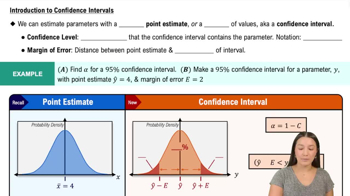
A confidence interval is a range of values, derived from sample statistics, that is likely to contain the true population parameter. It is expressed with a certain level of confidence, typically 95% or 99%, indicating the degree of certainty that the parameter lies within the interval. The width of the interval reflects the precision of the estimate; narrower intervals suggest more precise estimates.
Recommended video:
06:33
Introduction to Confidence Intervals

Level of Confidence

The level of confidence represents the probability that the confidence interval will contain the true population parameter if the same sampling method is repeated multiple times. Common levels of confidence are 90%, 95%, and 99%. Increasing the level of confidence results in a wider confidence interval, as it requires a broader range to ensure that the true parameter is captured within the interval.
Recommended video:
06:33
Introduction to Confidence Intervals

Margin of Error

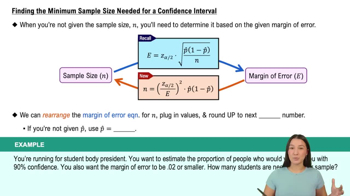
The margin of error is the amount of error that is allowed in the estimation of a population parameter. It is influenced by the level of confidence and the variability in the data. A higher margin of error leads to a wider confidence interval, as it accounts for greater uncertainty in the estimate, which is particularly relevant when the level of confidence is increased.
Recommended video:
04:08
Finding the Minimum Sample Size Needed for a Confidence Interval
Related Practice
Textbook Question

Constructing Confidence Intervals In Exercises 13–24, assume the sample is from a normally distributed population and construct the indicated confidence intervals for (a) the population variance σ^2. Interpret the results.

Drug Concentration The times (in minutes) for the drug concentration to peak when the drug epinephrine is injected into 15 randomly selected patients are listed. Use a 90% level of confidence.

Textbook Question

Cholesterol Contents of Cheese A cheese processing company wants to estimate the mean cholesterol content of all one-ounce servings of a type of cheese. The estimate must be within 0.75 milligram of the population mean.

a. Determine the minimum sample size required to construct a 95% confidence interval for the population mean. Assume the population standard deviation is 3.10 milligrams.

Textbook Question

Senate Filibuster You wish to estimate, with 99% confidence, the population proportion of U.S. adults who disapprove of the U.S Senate’s use of the filibuster. Your estimate must be accurate within 2% of the population proportion.

a. No preliminary estimate is available. Find the minimum sample size needed.

Textbook Question

Constructing Confidence Intervals In Exercises 13–24, assume the sample is from a normally distributed population and construct the indicated confidence intervals for (a) the population variance σ^2. Interpret the results.

Annual Precipitation The annual precipitation amounts (in inches) of a random sample of 61 years for Chicago, Illinois, have a sample standard deviation of 6.46. Use a 98% level of confidence. (Source: National Oceanic and Atmospheric Administration)

Textbook Question

Constructing a Confidence Interval In Exercises 25–28, use the data set to (a) find the sample mean. Assume the population is normally distributed.

SAT Scores The SAT scores of 12 randomly selected high school seniors

Textbook Question

Ages of College Students An admissions director wants to estimate the mean age of all students enrolled at a college. The estimate must be within 1.5 years of the population mean. Assume the population of ages is normally distributed.

a. Determine the minimum sample size required to construct a 90% confidence interval for the population mean. Assume the population standard deviation is 1.6 years.