
Ch. 6 - Confidence Intervals
Larson - Elementary Statistics: Picturing the World 8th Edition
Larson8th EditionElementary Statistics: Picturing the WorldISBN: 9780137493470Not the one you use?Change textbook
Chapter 6, Problem 6.1.50a

Ages of College Students An admissions director wants to estimate the mean age of all students enrolled at a college. The estimate must be within 1.5 years of the population mean. Assume the population of ages is normally distributed.
a. Determine the minimum sample size required to construct a 90% confidence interval for the population mean. Assume the population standard deviation is 1.6 years.

Verified step by step guidance
1
Step 1: Recall the formula for determining the minimum sample size required to estimate a population mean: n = (Z * σ / E)^2, where n is the sample size, Z is the critical value corresponding to the confidence level, σ is the population standard deviation, and E is the margin of error.
Step 2: Identify the given values from the problem: the confidence level is 90%, so the critical value Z can be found using a Z-table or standard normal distribution (Z ≈ 1.645 for 90% confidence level). The population standard deviation (σ) is 1.6 years, and the margin of error (E) is 1.5 years.
Step 3: Substitute the given values into the formula: n = (1.645 * 1.6 / 1.5)^2. Simplify the numerator and denominator inside the parentheses first.
Step 4: Square the result of the division to calculate the minimum sample size. Ensure that the final value of n is rounded up to the nearest whole number, as sample size must be an integer.
Step 5: Interpret the result: The calculated sample size represents the minimum number of students that must be sampled to ensure the estimate of the mean age is within 1.5 years of the population mean with 90% confidence.

Verified video answer for a similar problem:

This video solution was recommended by our tutors as helpful for the problem above.
Video duration:
1m
Was this helpful?

Key Concepts

Here are the essential concepts you must grasp in order to answer the question correctly.

Confidence Interval

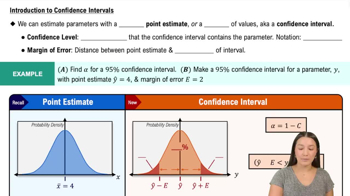
A confidence interval is a range of values, derived from a sample, that is likely to contain the population parameter (like the mean) with a specified level of confidence. For example, a 90% confidence interval means that if we were to take many samples and construct intervals, approximately 90% of those intervals would contain the true population mean.
Recommended video:
06:33
Introduction to Confidence Intervals

Sample Size Determination

Sample size determination involves calculating the number of observations needed to achieve a desired level of precision in estimating a population parameter. In this case, the formula incorporates the desired margin of error, the population standard deviation, and the critical value from the normal distribution corresponding to the confidence level.
Recommended video:
Guided course
06:14
Coefficient of Determination

Normal Distribution

The normal distribution is a continuous probability distribution characterized by its bell-shaped curve, defined by its mean and standard deviation. Many statistical methods, including confidence intervals, assume that the underlying population is normally distributed, which allows for the application of certain statistical techniques and the use of z-scores for calculations.
Recommended video:
06:23
Using the Normal Distribution to Approximate Binomial Probabilities
Related Practice
Textbook Question

Finite Population Correction Factor In Exercises 57 and 58, use the information below.

In this section, you studied the construction of a confidence interval to estimate a population mean. In each case, the underlying assumption was that the sample size n was small in comparison to the population size N. When n ≥ 0.05N however, the formula that determines the standard error of the mean needs to be adjusted, as shown below.

[IMAGE]

Recall from the Section 5.4 exercises that the expression sqrt[(N-n)/(n-1)] is called a finite population correction factor. The margin of error is

[IMAGE]

Use the finite population correction factor to construct each confidence interval for the population mean.

a. c = 0.99, xbar = 8.6, σ = 4.9, N = 200, n = 25.

Textbook Question

When all other quantities remain the same, how does the indicated change affect the width of a confidence interval? Explain.

a. Increase in the level of confidence

Textbook Question

Alcohol-Impaired Driving You wish to estimate, with 95% confidence, the population proportion of motor vehicle fatalities that were caused by alcohol-impaired driving. Your estimate must be accurate within 5% of the population proportion.

a. No preliminary estimate is available. Find the minimum sample size needed

Textbook Question

Juice Dispensing Machine A beverage company uses a machine to fill half-gallon bottles with fruit juice (see figure). The company wants to estimate the mean volume of water the machine is putting in the bottles within 0.25 fluid ounce.

[IMAGE]

a. Determine the minimum sample size required to construct a 95% confidence interval for the population mean. Assume the population standard deviation is 1 fluid ounce.

Textbook Question

Cholesterol Contents of Cheese A cheese processing company wants to estimate the mean cholesterol content of all one-ounce servings of a type of cheese. The estimate must be within 0.75 milligram of the population mean.

a. Determine the minimum sample size required to construct a 95% confidence interval for the population mean. Assume the population standard deviation is 3.10 milligrams.

Textbook Question

Constructing a Confidence Interval In Exercises 25–28, use the data set to (a) find the sample mean. Assume the population is normally distributed.

SAT Scores The SAT scores of 12 randomly selected high school seniors