

Ch. 6 - Confidence Intervals
Larson - Elementary Statistics: Picturing the World 8th Edition
Larson8th EditionElementary Statistics: Picturing the WorldISBN: 9780137493470Not the one you use?Change textbook
Chapter 6, Problem 6.4.14a

Constructing Confidence Intervals In Exercises 13–24, assume the sample is from a normally distributed population and construct the indicated confidence intervals for (a) the population variance σ^2. Interpret the results.
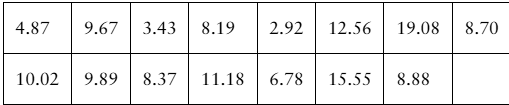
Drug Concentration The times (in minutes) for the drug concentration to peak when the drug epinephrine is injected into 15 randomly selected patients are listed. Use a 90% level of confidence.
Table displaying drug concentration peak times in minutes for 15 patients, with values ranging from 2.92 to 19.08.

Verified step by step guidance
1
Step 1: Calculate the sample variance (s^2). First, compute the sample mean (x̄) by summing all the data points and dividing by the number of observations (n = 15). Then, use the formula for variance: s^2 = (Σ(xi - x̄)^2) / (n - 1), where xi represents each data point.
Step 2: Identify the chi-square critical values for the given confidence level (90%) and degrees of freedom (df = n - 1 = 14). Use a chi-square distribution table or calculator to find the values for χ^2_lower and χ^2_upper.
Step 3: Construct the confidence interval for the population variance (σ^2) using the formula: [(n - 1) * s^2 / χ^2_upper, (n - 1) * s^2 / χ^2_lower]. This formula uses the sample variance and the chi-square critical values.
Step 4: To interpret the results, note that the confidence interval provides a range of plausible values for the population variance. A 90% confidence level means that if we were to repeat this process many times, 90% of the intervals would contain the true population variance.
Step 5: If needed, you can also calculate the confidence interval for the population standard deviation (σ) by taking the square root of the lower and upper bounds of the variance confidence interval.

Verified video answer for a similar problem:

This video solution was recommended by our tutors as helpful for the problem above.
Video duration:
4m
Was this helpful?

Key Concepts

Here are the essential concepts you must grasp in order to answer the question correctly.

Confidence Interval

A confidence interval is a range of values, derived from sample statistics, that is likely to contain the true population parameter with a specified level of confidence. For example, a 90% confidence interval suggests that if we were to take many samples and construct intervals in the same way, approximately 90% of those intervals would contain the true population parameter.
Recommended video:
06:33
Introduction to Confidence Intervals

Population Variance (σ²)

Population variance is a measure of the dispersion of a set of values in a population. It quantifies how much the values in the population differ from the population mean. In the context of confidence intervals, estimating the population variance is crucial for determining the width of the interval, as it affects the standard error of the mean.
Recommended video:
04:48
Population Standard Deviation Known

Normal Distribution

Normal distribution is a probability distribution that is symmetric about the mean, showing that data near the mean are more frequent in occurrence than data far from the mean. Many statistical methods, including the construction of confidence intervals, assume that the underlying population is normally distributed, especially when sample sizes are small.
Recommended video:
06:23
Using the Normal Distribution to Approximate Binomial Probabilities
Related Practice
Textbook Question

Constructing Confidence Intervals In Exercises 13–24, assume the sample is from a normally distributed population and construct the indicated confidence intervals for (a) the population variance σ^2. Interpret the results.

Drive-Thru Times The times (in seconds) spent by a random sample of 28 customers in the drive-thru of a fast-food restaurant have a sample standard deviation of 56.1. Use a 98% level of confidence.

Textbook Question

When all other quantities remain the same, how does the indicated change affect the width of a confidence interval? Explain.

a. Increase in the level of confidence

Textbook Question

Cholesterol Contents of Cheese A cheese processing company wants to estimate the mean cholesterol content of all one-ounce servings of a type of cheese. The estimate must be within 0.75 milligram of the population mean.

a. Determine the minimum sample size required to construct a 95% confidence interval for the population mean. Assume the population standard deviation is 3.10 milligrams.

Textbook Question

Senate Filibuster You wish to estimate, with 99% confidence, the population proportion of U.S. adults who disapprove of the U.S Senate’s use of the filibuster. Your estimate must be accurate within 2% of the population proportion.

a. No preliminary estimate is available. Find the minimum sample size needed.

Textbook Question

Constructing Confidence Intervals In Exercises 13–24, assume the sample is from a normally distributed population and construct the indicated confidence intervals for (a) the population variance σ^2. Interpret the results.

Annual Precipitation The annual precipitation amounts (in inches) of a random sample of 61 years for Chicago, Illinois, have a sample standard deviation of 6.46. Use a 98% level of confidence. (Source: National Oceanic and Atmospheric Administration)

Textbook Question

Constructing a Confidence Interval In Exercises 25–28, use the data set to (a) find the sample mean. Assume the population is normally distributed.

SAT Scores The SAT scores of 12 randomly selected high school seniors