Ch. 2 - Descriptive Statistics
Larson - Elementary Statistics: Picturing the World 8th Edition
Larson8th EditionElementary Statistics: Picturing the WorldISBN: 9780137493470Not the one you use?Change textbook
Chapter 2, Problem 2.R.11

The heights (in feet) and the number of stories of the ten tallest buildings in New York City are listed. Use a scatter plot to display the data. Describe any patterns. (Source: Emporis)
tab1

Verified step by step guidance
1
Step 1: Organize the data into two variables: 'Height in feet' and 'Number of stories'. These will serve as the x-axis and y-axis for the scatter plot, respectively.
Step 2: Create a scatter plot by plotting each pair of values (height, stories) as a point on a Cartesian plane. For example, the first point would be (1776, 104), the second point (1550, 95), and so on.
Step 3: Label the axes of the scatter plot. The x-axis should represent 'Height in feet', and the y-axis should represent 'Number of stories'. Include appropriate units for clarity.
Step 4: Analyze the scatter plot for patterns. Look for trends such as whether taller buildings tend to have more stories, or if there are any outliers that deviate significantly from the general trend.
Step 5: Summarize the observed patterns. For example, you might note whether there is a positive correlation between height and the number of stories, or if the relationship appears non-linear or inconsistent.

Verified video answer for a similar problem:

This video solution was recommended by our tutors as helpful for the problem above.
Video duration:
2m
Was this helpful?

Key Concepts

Here are the essential concepts you must grasp in order to answer the question correctly.

Scatter Plot

A scatter plot is a graphical representation that uses dots to display values for two different variables. In this case, the heights of buildings are plotted on one axis and the number of stories on the other. This visualization helps identify relationships or patterns between the two variables, such as whether taller buildings tend to have more stories.
Recommended video:
Guided course
07:38
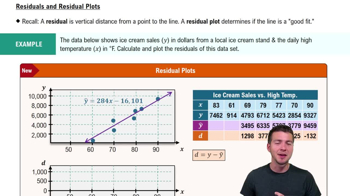
Residuals and Residual Plots

Correlation

Correlation refers to the statistical relationship between two variables, indicating how one may change in relation to the other. In the context of the scatter plot, a positive correlation would suggest that as the height of a building increases, the number of stories also increases, while a negative correlation would indicate the opposite. Understanding correlation is essential for interpreting the patterns observed in the data.
Recommended video:
Guided course
05:43
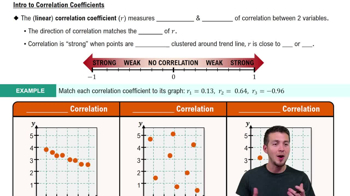
Correlation Coefficient

Descriptive Statistics

Descriptive statistics summarize and describe the main features of a dataset. This includes measures such as mean, median, and range, which provide insights into the central tendency and variability of the data. In analyzing the scatter plot, descriptive statistics can help quantify the relationship between building height and the number of stories, aiding in a more comprehensive understanding of the data.
Recommended video:
Guided course
05:53
Parameters vs. Statistics
Related Practice
Textbook Question

From a random sample of airplanes, the number of defects found in their fuselages are listed. Find the sample mean and the sample standard deviation of the data.

Textbook Question

The data set represents the number of minutes a sample of 27 people exercise each week.

108 139 120 123 120 132 123 131 131

157 150 124 111 101 135 119 116 117

127 128 139 119 118 114 127 142 130


g. Display the data using a box-and-whisker plot.

1
views
Textbook Question

The data set represents the number of minutes a sample of 27 people exercise each week.

108 139 120 123 120 132 123 131 131

157 150 124 111 101 135 119 116 117

127 128 139 119 118 114 127 142 130


a. Construct a frequency distribution for the data set using five classes. Include class limits, midpoints, boundaries, frequencies, relative frequencies, and cumulative frequencies.

1
views
Textbook Question

The data set represents the number of minutes a sample of 27 people exercise each week.

108 139 120 123 120 132 123 131 131

157 150 124 111 101 135 119 116 117

127 128 139 119 118 114 127 142 130

b. Display the data using a frequency histogram and a frequency polygon on the same axes.

Textbook Question

The mean sale per customer for 40 customers at a gas station is \$32.00, with a standard deviation of \$4.00. Using Chebychev’s Theorem, determine at least how many of the customers spent between \$24.00 and \$40.00.

Textbook Question

Describe the shape of the distribution for the histogram you made in Exercise 3 as symmetric, uniform, skewed left, skewed right, or none of these.

1
views