Ch. 2 - Descriptive Statistics
Larson - Elementary Statistics: Picturing the World 8th Edition
Larson8th EditionElementary Statistics: Picturing the WorldISBN: 9780137493470Not the one you use?Change textbook
Chapter 2, Problem 2.R.19

Describe the shape of the distribution for the histogram you made in Exercise 3 as symmetric, uniform, skewed left, skewed right, or none of these.

Verified step by step guidance
1
Review the histogram created in Exercise 3 and observe the overall shape of the data distribution.
Check if the histogram is symmetric by determining if the left and right sides of the distribution are approximately mirror images of each other.
Examine if the histogram is uniform by checking if all the bars have roughly the same height, indicating equal frequencies across intervals.
Determine if the histogram is skewed left by observing if the tail of the distribution extends more to the left (towards smaller values).
Determine if the histogram is skewed right by observing if the tail of the distribution extends more to the right (towards larger values). If none of these apply, classify the shape as 'none of these.'

Verified video answer for a similar problem:

This video solution was recommended by our tutors as helpful for the problem above.
Video duration:
2m
Was this helpful?

Key Concepts

Here are the essential concepts you must grasp in order to answer the question correctly.

Distribution Shape

The shape of a distribution refers to the visual representation of data points in a histogram. Common shapes include symmetric, where both sides mirror each other; uniform, where all values have similar frequencies; and skewed, where one tail is longer than the other. Understanding these shapes helps in interpreting the underlying data characteristics.
Recommended video:
05:11
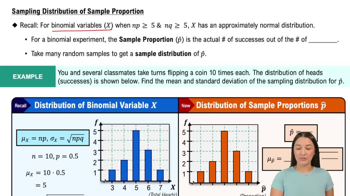
Sampling Distribution of Sample Proportion

Skewness

Skewness measures the asymmetry of a distribution. A distribution is skewed left (negatively skewed) if it has a longer left tail, indicating that most data points are concentrated on the right. Conversely, a right skew (positively skewed) has a longer right tail, suggesting that most data points are on the left. Recognizing skewness is crucial for understanding data behavior.
Recommended video:
04:41
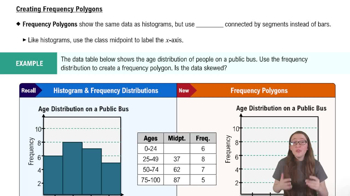
Creating Frequency Polygons

Symmetry in Distributions

A symmetric distribution has equal frequencies on both sides of its center, resulting in a balanced shape. The mean, median, and mode of a symmetric distribution are all located at the center. Identifying symmetry is important for statistical analysis, as it influences the choice of statistical tests and the interpretation of results.
Recommended video:
Guided course
06:38
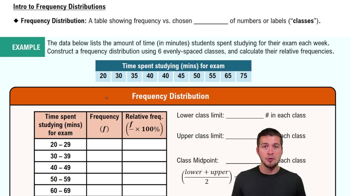
Intro to Frequency Distributions