Ch. 2 - Descriptive Statistics
Larson - Elementary Statistics: Picturing the World 8th Edition
Larson8th EditionElementary Statistics: Picturing the WorldISBN: 9780137493470Not the one you use?Change textbook
Chapter 2, Problem 2.Q.1a

The data set represents the number of minutes a sample of 27 people exercise each week.
108 139 120 123 120 132 123 131 131
157 150 124 111 101 135 119 116 117
127 128 139 119 118 114 127 142 130


a. Construct a frequency distribution for the data set using five classes. Include class limits, midpoints, boundaries, frequencies, relative frequencies, and cumulative frequencies.

Verified step by step guidance
1
Step 1: Determine the range of the data. To do this, subtract the smallest value in the data set from the largest value. Identify the smallest value (101) and the largest value (157), then calculate the range as: R=largest-smallest.
Step 2: Determine the class width. Divide the range by the number of classes (5) and round up to the nearest whole number. Use the formula: W=Rn, where n is the number of classes.
Step 3: Create the class limits. Start with the smallest value in the data set as the lower limit of the first class. Add the class width to determine the upper limit of the first class. Repeat this process to create the remaining class limits for all five classes.
Step 4: Calculate the midpoints, boundaries, and frequencies. The midpoint of each class is calculated as: M=Lower+Upper2. The boundaries are found by subtracting 0.5 from the lower limit and adding 0.5 to the upper limit of each class. Count the number of data points that fall within each class to determine the frequency.
Step 5: Calculate the relative frequencies and cumulative frequencies. The relative frequency for each class is calculated as: RF=FN, where F is the frequency of the class and N is the total number of data points. The cumulative frequency is the running total of frequencies as you move from the first class to the last.

Verified video answer for a similar problem:

This video solution was recommended by our tutors as helpful for the problem above.
Video duration:
6m
Was this helpful?

Key Concepts

Here are the essential concepts you must grasp in order to answer the question correctly.

Frequency Distribution

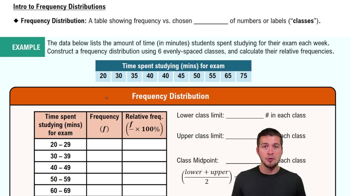
A frequency distribution is a summary of how often each value occurs in a data set. It organizes data into classes or intervals, showing the number of observations (frequency) that fall within each class. This helps in visualizing the distribution of data and identifying patterns or trends.
Recommended video:
Guided course
06:38
Intro to Frequency Distributions

Class Limits and Midpoints

Class limits define the range of values that fall into each class in a frequency distribution. The midpoint is the average of the upper and lower class limits, representing a central value for that class. These concepts are essential for summarizing data and calculating statistics like the mean.
Recommended video:
04:15
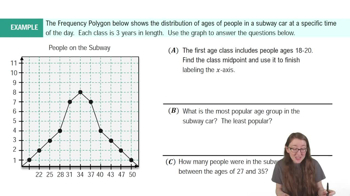
Frequency Polygons Example 1

Relative and Cumulative Frequencies

Relative frequency is the proportion of the total number of observations that fall within a specific class, calculated by dividing the class frequency by the total number of observations. Cumulative frequency is the running total of frequencies up to a certain class, providing insight into the data's distribution and helping to determine percentiles.
Recommended video:
Guided course
06:38
Intro to Frequency Distributions