Ch. 2 - Descriptive Statistics
Larson - Elementary Statistics: Picturing the World 8th Edition
Larson8th EditionElementary Statistics: Picturing the WorldISBN: 9780137493470Not the one you use?Change textbook
Chapter 2, Problem 2.T.1

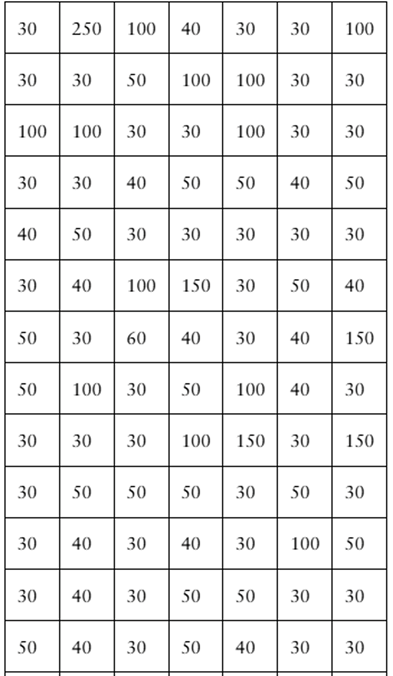
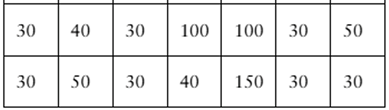
According to data from the city of Toronto, Ontario, Canada, there were nearly 112,000 parking infractions in the city for December 2020, with fines totaling over 5,500,000 Canadian dollars. The fines (in Canadian dollars) for a random sample of 105 parking infractions in Toronto, Ontario, Canada, for December 2020 are listed below. (Source: City of Toronto)


Table displaying a dataset of parking fines in Toronto, with values ranging from 30 to 250 Canadian dollars.
Table displaying a sample of parking fines in Canadian dollars for December 2020 in Toronto, with values organized in rows and columns.
In Exercises 1–5, use technology. If possible, print your results.


Find the sample mean of the data.

Verified step by step guidance
1
Step 1: Understand the problem. The goal is to calculate the sample mean of the fines listed in the dataset. The sample mean is the average of all the values in the dataset.
Step 2: Organize the data. The fines are listed in the images provided. Combine all the values into a single list for calculation purposes.
Step 3: Use the formula for the sample mean: \( \text{Sample Mean} = \frac{\sum x_i}{n} \), where \( x_i \) represents each individual fine and \( n \) is the total number of fines in the sample.
Step 4: Add all the fines together to calculate \( \sum x_i \). This involves summing up all the values provided in the dataset.
Step 5: Divide the total sum of fines (\( \sum x_i \)) by the total number of fines (\( n = 105 \)) to compute the sample mean.

Verified video answer for a similar problem:

This video solution was recommended by our tutors as helpful for the problem above.
Video duration:
2m
Was this helpful?

Key Concepts

Here are the essential concepts you must grasp in order to answer the question correctly.

Sample Mean

The sample mean is the average of a set of values obtained from a sample of a population. It is calculated by summing all the values in the sample and dividing by the number of observations. The sample mean provides a measure of central tendency, helping to summarize the data and understand its overall behavior.
Recommended video:
05:11
Sampling Distribution of Sample Proportion

Descriptive Statistics

Descriptive statistics are methods for summarizing and organizing data to provide a clear overview of its main features. This includes measures such as mean, median, mode, and standard deviation, which help to describe the data's distribution and variability. Descriptive statistics are essential for interpreting data before conducting further analysis.
Recommended video:
Guided course
05:53
Parameters vs. Statistics

Data Visualization

Data visualization involves representing data graphically to identify patterns, trends, and insights more easily. Techniques such as charts, graphs, and tables help convey complex information in a more digestible format. In the context of the parking fines data, visualizing the distribution of fines can enhance understanding and facilitate comparisons.
Recommended video:
Guided course
04:39
Visualizing Qualitative vs. Quantitative Data
Related Practice