Ch. 2 - Descriptive Statistics
Larson - Elementary Statistics: Picturing the World 8th Edition
Larson8th EditionElementary Statistics: Picturing the WorldISBN: 9780137493470Not the one you use?Change textbook
Chapter 2, Problem 2.T.1d

The overall averages of 12 students in a statistics class prior to taking the final exam are listed.
67 72 88 73 99 85 81 87 63 94 68 87


d. Display the data in a stem-and-leaf plot. Use one line per stem.

Verified step by step guidance
1
Step 1: Understand the stem-and-leaf plot. A stem-and-leaf plot is a way to organize numerical data by separating each value into a 'stem' (all but the last digit) and a 'leaf' (the last digit). For example, the number 67 would have a stem of 6 and a leaf of 7.
Step 2: Identify the range of the data. The smallest value is 63, and the largest value is 99. This means the stems will range from 6 to 9 (representing the tens place).
Step 3: Create the stems. Write down the stems (6, 7, 8, and 9) in a vertical column, each on its own line. These represent the tens place of the numbers.
Step 4: Assign the leaves to their respective stems. For each number in the data set, write the last digit (the leaf) next to the corresponding stem. For example, for the number 67, write the leaf 7 next to the stem 6. Repeat this for all numbers in the data set.
Step 5: Organize the leaves in ascending order for each stem. Once all the leaves are assigned, sort them in increasing order for each stem to make the plot easier to read. For example, if the leaves for stem 6 are 7, 3, and 8, rearrange them as 3, 7, 8.

Verified video answer for a similar problem:

This video solution was recommended by our tutors as helpful for the problem above.
Video duration:
2m
Was this helpful?

Key Concepts

Here are the essential concepts you must grasp in order to answer the question correctly.

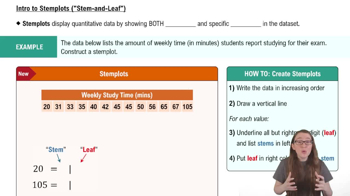
Stem-and-Leaf Plot

A stem-and-leaf plot is a method of displaying quantitative data in a graphical format, similar to a histogram, that helps visualize the distribution of the data. Each number is split into a 'stem' (the leading digit or digits) and a 'leaf' (the trailing digit). This format retains the original data values while providing a clear view of the data's shape and distribution.
Recommended video:
06:23
Creating Stemplots

Data Organization

Organizing data is crucial for effective analysis and interpretation. In the context of a stem-and-leaf plot, data must be sorted in ascending order to accurately represent the distribution. This organization allows for easier identification of patterns, such as clusters or gaps in the data, which can inform further statistical analysis.
Recommended video:
Guided course
04:39
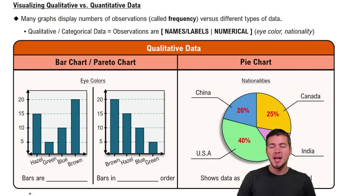
Visualizing Qualitative vs. Quantitative Data

Descriptive Statistics

Descriptive statistics summarize and describe the main features of a dataset. Key measures include the mean, median, mode, and range, which provide insights into the central tendency and variability of the data. Understanding these concepts is essential for interpreting the results displayed in a stem-and-leaf plot and for making informed conclusions about the dataset.
Recommended video:
Guided course
05:53
Parameters vs. Statistics
Related Practice
Textbook Question

Use frequency distribution formulas to estimate the sample mean and the sample standard deviation of the data set in Exercise 2.
Textbook Question

In Exercises 5 and 6, use the data set, which represents the number of rooms reserved during one night’s business at a sample of hotels.


153 104 118 166 89 104 100 79 93 96 116

94 140 84 81 96 108 111 87 126 101 111

122 108 126 93 108 87 103 95 129 93 124


Construct a frequency distribution for the data set with six classes and draw a frequency polygon.

Textbook Question

For the four test scores 96, 85, 91, and 86, the first 3 test scores are 20% of the final grade, and the last test score is 40% of the final grade. Find the weighted mean of the test scores.

Textbook Question

The overall averages of 12 students in a statistics class prior to taking the final exam are listed.

67 72 88 73 99 85 81 87 63 94 68 87


a. Find the mean, median, and mode of the data set. Which best represents the center of the data?

Textbook Question

According to data from the city of Toronto, Ontario, Canada, there were nearly 112,000 parking infractions in the city for December 2020, with fines totaling over 5,500,000 Canadian dollars. The fines (in Canadian dollars) for a random sample of 105 parking infractions in Toronto, Ontario, Canada, for December 2020 are listed below. (Source: City of Toronto)


In Exercises 1–5, use technology. If possible, print your results.


Find the sample mean of the data.

Textbook Question

In Exercises 1 and 2, use the data set, which represents the overall average class sizes for 20 national universities. (Adapted from Public University Honors)

37 34 42 44 39 40 41 51 49 31

52 26 31 40 30 27 36 43 48 35


Construct a relative frequency histogram using the frequency distribution in Exercise 1. Then determine which class has the greatest relative frequency and which has the least relative frequency.

1
views