Ch. 2 - Descriptive Statistics
Larson - Elementary Statistics: Picturing the World 8th Edition
Larson8th EditionElementary Statistics: Picturing the WorldISBN: 9780137493470Not the one you use?Change textbook
Chapter 2, Problem 2.RE.16

For the four test scores 96, 85, 91, and 86, the first 3 test scores are 20% of the final grade, and the last test score is 40% of the final grade. Find the weighted mean of the test scores.

Verified step by step guidance
1
Step 1: Understand the concept of a weighted mean. A weighted mean is calculated by multiplying each value by its respective weight, summing these products, and then dividing by the sum of the weights.
Step 2: Assign weights to each test score. The first three test scores (96, 85, 91) each have a weight of 20% (or 0.2), and the last test score (86) has a weight of 40% (or 0.4).
Step 3: Multiply each test score by its respective weight. For example, calculate 96 × 0.2, 85 × 0.2, 91 × 0.2, and 86 × 0.4.
Step 4: Add the weighted values obtained in Step 3. This gives the numerator of the weighted mean formula.
Step 5: Divide the sum from Step 4 by the total weight. The total weight is 0.2 + 0.2 + 0.2 + 0.4 = 1. This division gives the weighted mean of the test scores.

Verified video answer for a similar problem:

This video solution was recommended by our tutors as helpful for the problem above.
Video duration:
1m
Was this helpful?

Key Concepts

Here are the essential concepts you must grasp in order to answer the question correctly.

Weighted Mean

The weighted mean is an average that takes into account the relative importance or weight of each value in a dataset. In this case, different test scores contribute differently to the final grade based on their assigned weights. The formula for the weighted mean is the sum of each score multiplied by its weight, divided by the total of the weights.
Recommended video:
Guided course
04:52
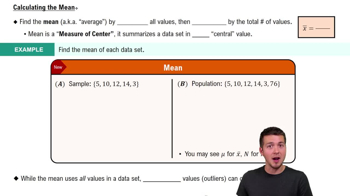
Calculating the Mean

Weights in Grading

Weights in grading refer to the proportionate influence that each component of a course has on the final grade. In this scenario, the first three test scores account for 20% each, while the last test score accounts for 40%. Understanding how these weights are distributed is crucial for calculating the overall performance accurately.
Recommended video:
04:24
Constructing Confidence Intervals for Proportions Example 2

Calculation of Averages

Calculating averages involves summing a set of values and dividing by the number of values. For weighted averages, however, each value is multiplied by its respective weight before summing. This method ensures that more significant contributions to the average are appropriately represented, which is essential for accurately reflecting a student's performance based on varying test importance.
Recommended video:
Guided course
04:51
Find 5-Number Summary - TI-84 Calculator
Related Practice
Textbook Question

The overall averages of 12 students in a statistics class prior to taking the final exam are listed.

67 72 88 73 99 85 81 87 63 94 68 87


d. Display the data in a stem-and-leaf plot. Use one line per stem.

Textbook Question

In Exercises 5 and 6, use the data set, which represents the number of rooms reserved during one night’s business at a sample of hotels.


153 104 118 166 89 104 100 79 93 96 116

94 140 84 81 96 108 111 87 126 101 111

122 108 126 93 108 87 103 95 129 93 124


Construct a frequency distribution for the data set with six classes and draw a frequency polygon.

Textbook Question

In Exercises 37– 40, use the data set, which represents the model 2020 vehicles with the highest fuel economies (in miles per gallon) in the most popular classes. (Source: U.S. Environmental Protection Agency)

36 30 30 45 31 113 113 33 33 33 52 141 56 117 58

118 50 26 23 23 27 48 22 22 22 121 41 105 35 35


About how many vehicles fall on or below the third quartile?

Textbook Question

In Exercises 13 and 14, find the mean, the median, and the mode of the data, if possible. If any measure cannot be found or does not represent the center of the data, explain why.


The responses of 1019 adults who were asked how much money they think they will spend on Christmas gifts in a recent year (Adapted from Gallup)


" style="" width="500">

Textbook Question

According to data from the city of Toronto, Ontario, Canada, there were nearly 112,000 parking infractions in the city for December 2020, with fines totaling over 5,500,000 Canadian dollars. The fines (in Canadian dollars) for a random sample of 105 parking infractions in Toronto, Ontario, Canada, for December 2020 are listed below. (Source: City of Toronto)


In Exercises 1–5, use technology. If possible, print your results.


Find the sample mean of the data.

Textbook Question

In Exercises 1 and 2, use the data set, which represents the overall average class sizes for 20 national universities. (Adapted from Public University Honors)

37 34 42 44 39 40 41 51 49 31

52 26 31 40 30 27 36 43 48 35


Construct a relative frequency histogram using the frequency distribution in Exercise 1. Then determine which class has the greatest relative frequency and which has the least relative frequency.

1
views