Ch. 2 - Descriptive Statistics
Larson - Elementary Statistics: Picturing the World 8th Edition
Larson8th EditionElementary Statistics: Picturing the WorldISBN: 9780137493470Not the one you use?Change textbook
Chapter 2, Problem 2.T.2c

The data set represents the number of movies that a sample of 20 people watched in a year.
121 148 94 142 170 88 221 106 18 67
149 28 60 101 134 168 92 154 53 66


c. Display the data using a relative frequency histogram.

Verified step by step guidance
1
Organize the data into intervals (also called bins). To do this, determine the range of the data by subtracting the smallest value (18) from the largest value (221). Then, decide on the number of intervals (commonly 5-10) and calculate the bin width by dividing the range by the number of intervals. Round up to a convenient number if necessary.
Create a frequency table. Count how many data points fall into each interval (bin). This will give you the frequency for each bin.
Calculate the relative frequency for each bin. Divide the frequency of each bin by the total number of data points (20 in this case). The formula is: FrequencyTotal.
Construct the relative frequency histogram. On the x-axis, label the intervals (bins). On the y-axis, label the relative frequencies. Draw bars for each bin where the height of the bar corresponds to the relative frequency of that bin.
Ensure the histogram is properly labeled. Add a title to the histogram, label the axes, and ensure the bars are evenly spaced and accurately represent the relative frequencies.

Verified video answer for a similar problem:

This video solution was recommended by our tutors as helpful for the problem above.
Video duration:
10m
Was this helpful?

Key Concepts

Here are the essential concepts you must grasp in order to answer the question correctly.

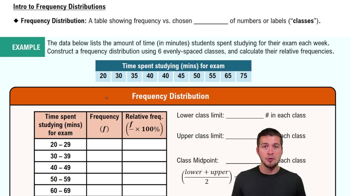
Relative Frequency

Relative frequency is the ratio of the number of times a particular value occurs in a data set to the total number of observations. It provides a way to understand the proportion of each category relative to the whole, which is essential for creating a histogram that accurately represents the data distribution.
Recommended video:
Guided course
06:38
Intro to Frequency Distributions

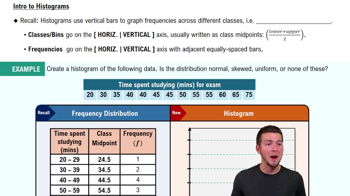
Histogram

A histogram is a graphical representation of the distribution of numerical data, where the data is divided into intervals (bins) and the frequency of data points within each bin is represented by the height of bars. It visually summarizes the data, making it easier to identify patterns, trends, and outliers.
Recommended video:
Guided course
05:54
Intro to Histograms

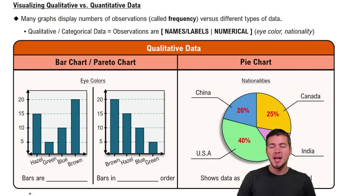
Binning Data

Binning data involves grouping continuous data into discrete intervals or 'bins' to facilitate analysis and visualization. The choice of bin width can significantly affect the appearance of the histogram and the interpretation of the data, making it crucial to select appropriate bins to accurately reflect the underlying distribution.
Recommended video:
Guided course
04:39
Visualizing Qualitative vs. Quantitative Data
Related Practice
Textbook Question

Use frequency distribution formulas to estimate the sample mean and the sample standard deviation of the data set in Exercise 2.
Textbook Question

"According to data from the city of Toronto, Ontario, Canada, there were nearly 112,000 parking infractions in the city for December 2020, with fines totaling over 5,500,000 Canadian dollars. The fines (in Canadian dollars) for a random sample of 105 parking infractions in Toronto, Ontario, Canada, for December 2020 are listed below. (Source: City of Toronto)


In Exercises 1–5, use technology. If possible, print your results.


Draw a histogram for the data. Does the distribution appear to be bell-shaped?"

Textbook Question

The table lists the number of albums by The Beatles that received sales certifications. Display the data using (b) a Pareto chart. (Source: Recording Industry Association of America)

Textbook Question

The overall averages of 12 students in a statistics class prior to taking the final exam are listed.

67 72 88 73 99 85 81 87 63 94 68 87


a. Find the mean, median, and mode of the data set. Which best represents the center of the data?

Textbook Question

The number of minutes it took 12 students in a statistics class to complete the final exam are listed. Use a scatter plot to display this data set and the data set in Exercise 1. The data sets are in the same order. Describe any patterns.

61 85 67 48 54 61 59 80 67 55 88 84

Textbook Question

According to data from the city of Toronto, Ontario, Canada, there were nearly 112,000 parking infractions in the city for December 2020, with fines totaling over 5,500,000 Canadian dollars. The fines (in Canadian dollars) for a random sample of 105 parking infractions in Toronto, Ontario, Canada, for December 2020 are listed below. (Source: City of Toronto)


In Exercises 1–5, use technology. If possible, print your results.


Find the sample mean of the data.