Ch. 6 - Confidence Intervals
Larson - Elementary Statistics: Picturing the World 8th Edition
Larson8th EditionElementary Statistics: Picturing the WorldISBN: 9780137493470Not the one you use?Change textbook
Chapter 6, Problem 6.R.30

In Exercises 27–30, find the critical values and for the level of confidence c and sample size n.
c = 0.99, n = 10

Verified step by step guidance
1
Step 1: Understand the problem. The goal is to find the critical values for a given confidence level (c = 0.99) and sample size (n = 10). Critical values are used in hypothesis testing and confidence intervals to determine the range of values that are likely to contain the population parameter.
Step 2: Determine the degrees of freedom (df). For a t-distribution, the degrees of freedom are calculated as df = n - 1. Since n = 10, calculate df = 10 - 1.
Step 3: Identify the confidence level and the corresponding significance level (α). The confidence level is c = 0.99, so the significance level is α = 1 - c = 1 - 0.99.
Step 4: Divide the significance level (α) by 2 to find the area in each tail of the t-distribution. This is because the t-distribution is symmetric, and the critical values are located at the tails. Calculate α/2.
Step 5: Use a t-distribution table or statistical software to find the critical t-values for the given degrees of freedom (df) and the area in each tail (α/2). These critical values will correspond to the boundaries of the confidence interval.

Verified video answer for a similar problem:

This video solution was recommended by our tutors as helpful for the problem above.
Video duration:
2m
Was this helpful?

Key Concepts

Here are the essential concepts you must grasp in order to answer the question correctly.

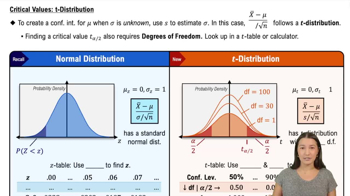
Critical Values

Critical values are the points on the scale of the test statistic that define the boundaries for rejecting the null hypothesis. They are determined based on the desired level of confidence and the distribution of the test statistic. For example, in a normal distribution, critical values correspond to specific z-scores that capture the central area of the distribution, reflecting the confidence level.
Recommended video:
05:50
Critical Values: t-Distribution

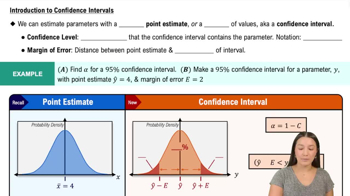
Level of Confidence

The level of confidence, denoted as 'c', represents the probability that the confidence interval will contain the true population parameter. A higher confidence level, such as 0.99, indicates a greater certainty that the interval includes the parameter, but it also results in a wider interval. This concept is crucial for understanding how confident we can be in our estimates based on sample data.
Recommended video:
06:33
Introduction to Confidence Intervals

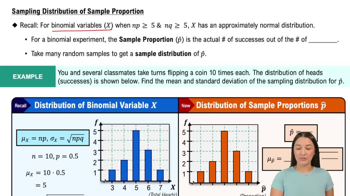
Sample Size

Sample size, denoted as 'n', refers to the number of observations or data points collected in a study. It plays a significant role in statistical analysis, as larger sample sizes generally lead to more reliable estimates and narrower confidence intervals. In this context, a sample size of 10 may limit the precision of the confidence interval, affecting the critical values derived from it.
Recommended video:
05:11
Sampling Distribution of Sample Proportion
Related Practice
Textbook Question

In a random sample of 36 top-rated roller coasters, the average height is 165 feet and the standard deviation is 67 feet. Construct a 90% confidence interval for μ. Interpret the results. (Source: POP World Media, LLC)

Textbook Question

In Exercises 19–22, let p be the population proportion for the situation. (a) Find point estimates of p and q, (b) construct 90% and 95% confidence intervals for p, and (c) interpret the results of part (b) and compare the widths of the confidence intervals.

In a survey of 912 U.S. adults in Generation Z (born after 1996), 383 said they are at least somewhat likely to consider an electric vehicle for their next vehicle purchase. (Adapted from Pew Research Center)

Textbook Question

You wish to estimate, with 95% confidence, the population proportion of U.S. adults who have taken or planned to take a winter vacation in a recent year. Your estimate must be accurate within 5% of the population proportion.

a. No preliminary estimate is available. Find the minimum sample size needed.

Textbook Question

In Exercises 19–22, let p be the population proportion for the situation. (a) Find point estimates of p and q, (b) construct 90% and 95% confidence intervals for p, and (c) interpret the results of part (b) and compare the widths of the confidence intervals.

In a survey of 73,901 college graduates, 23,991 obtained a postgraduate degree. (Adapted from Gallup)

Textbook Question

In Exercises 13–16, (a) find the margin of error for the values of c, s, and n, and (b) construct the confidence interval for using the t-distribution. Assume the population is normally distributed.

c = 0.90, s = 25.6, n = 16, xbar = 72.1

Textbook Question

In Exercise 19, would it be unusual for the population proportion to be 38%? Explain.