
Ch. 6 - Confidence Intervals
Larson - Elementary Statistics: Picturing the World 8th Edition
Larson8th EditionElementary Statistics: Picturing the WorldISBN: 9780137493470Not the one you use?Change textbook
Chapter 6, Problem 6.R.21

In Exercises 19–22, let p be the population proportion for the situation. (a) Find point estimates of p and q, (b) construct 90% and 95% confidence intervals for p, and (c) interpret the results of part (b) and compare the widths of the confidence intervals.
In a survey of 73,901 college graduates, 23,991 obtained a postgraduate degree. (Adapted from Gallup)

Verified step by step guidance
1
Step 1: Calculate the point estimates for p and q. The population proportion p is estimated as the ratio of the number of successes (graduates with postgraduate degrees) to the total number of observations (total graduates). Use the formula p = x / n, where x = 23,991 and n = 73,901. Then, calculate q as q = 1 - p.
Step 2: Construct the 90% confidence interval for p. Use the formula for a confidence interval: CI = p ± Z * sqrt((p * q) / n), where Z is the critical value for the desired confidence level (for 90%, Z ≈ 1.645). Substitute the values of p, q, and n into the formula to calculate the margin of error and the interval.
Step 3: Construct the 95% confidence interval for p. Use the same formula as in Step 2, but with the critical value Z ≈ 1.96 for a 95% confidence level. Again, substitute the values of p, q, and n to calculate the margin of error and the interval.
Step 4: Interpret the results of the confidence intervals. Explain that the 90% confidence interval means we are 90% confident that the true population proportion p lies within the interval, and similarly, the 95% confidence interval means we are 95% confident that the true population proportion p lies within the interval.
Step 5: Compare the widths of the confidence intervals. Note that the 95% confidence interval is wider than the 90% confidence interval because a higher confidence level requires a larger margin of error to ensure the true population proportion is captured within the interval.

Verified video answer for a similar problem:

This video solution was recommended by our tutors as helpful for the problem above.
Video duration:
6m
Was this helpful?

Key Concepts

Here are the essential concepts you must grasp in order to answer the question correctly.

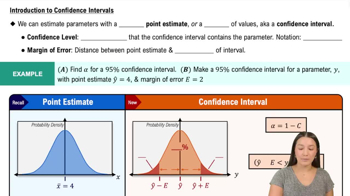
Point Estimate

A point estimate is a single value that serves as an approximation of a population parameter. In this context, the point estimate for the population proportion p is calculated by dividing the number of individuals with a postgraduate degree by the total number of surveyed individuals. This provides a quick snapshot of the proportion of graduates who pursued further education.
Recommended video:
06:33
Introduction to Confidence Intervals

Confidence Interval

A confidence interval is a range of values, derived from sample statistics, that is likely to contain the true population parameter with a specified level of confidence. For example, a 90% confidence interval suggests that if we were to take many samples, approximately 90% of the calculated intervals would contain the true population proportion p. This concept is crucial for understanding the precision and reliability of the point estimate.
Recommended video:
06:33
Introduction to Confidence Intervals

Width of Confidence Intervals

The width of a confidence interval reflects the level of uncertainty associated with the estimate of the population parameter. A wider interval indicates greater uncertainty, while a narrower interval suggests more precision. Comparing the widths of 90% and 95% confidence intervals helps to illustrate the trade-off between confidence level and precision, as higher confidence levels typically result in wider intervals.
Recommended video:
06:33
Introduction to Confidence Intervals