
Ch. 6 - Confidence Intervals
Larson - Elementary Statistics: Picturing the World 8th Edition
Larson8th EditionElementary Statistics: Picturing the WorldISBN: 9780137493470Not the one you use?Change textbook
Chapter 6, Problem 6.R.13

In Exercises 13–16, (a) find the margin of error for the values of c, s, and n, and (b) construct the confidence interval for using the t-distribution. Assume the population is normally distributed.
c = 0.90, s = 25.6, n = 16, xbar = 72.1

Verified step by step guidance
1
Step 1: Identify the given values and understand the problem. Here, c = 0.90 (confidence level), s = 25.6 (sample standard deviation), n = 16 (sample size), and x̄ = 72.1 (sample mean). The goal is to calculate the margin of error and construct the confidence interval using the t-distribution.
Step 2: Calculate the degrees of freedom (df) for the t-distribution. The formula is df = n - 1. Substitute n = 16 into the formula to find df.
Step 3: Determine the critical t-value (t*) for the given confidence level (c = 0.90) and degrees of freedom (df). Use a t-distribution table or statistical software to find t* corresponding to a two-tailed test with a 90% confidence level.
Step 4: Compute the margin of error (E) using the formula E = t* × (s / √n). Substitute the values of t*, s = 25.6, and n = 16 into the formula. Simplify the expression to find E.
Step 5: Construct the confidence interval for the population mean (μ) using the formula: Confidence Interval = x̄ ± E. Substitute x̄ = 72.1 and the calculated margin of error (E) into the formula to express the confidence interval.

Verified video answer for a similar problem:

This video solution was recommended by our tutors as helpful for the problem above.
Video duration:
5m
Was this helpful?

Key Concepts

Here are the essential concepts you must grasp in order to answer the question correctly.

Margin of Error

The margin of error quantifies the uncertainty in a sample estimate. It is calculated using the formula: Margin of Error = t * (s / √n), where t is the t-score corresponding to the desired confidence level, s is the sample standard deviation, and n is the sample size. A smaller margin of error indicates a more precise estimate of the population parameter.
Recommended video:
04:08
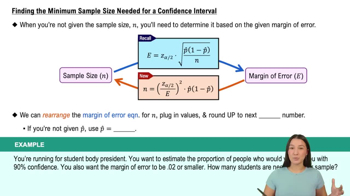
Finding the Minimum Sample Size Needed for a Confidence Interval

Confidence Interval

A confidence interval is a range of values, derived from a sample, that is likely to contain the population parameter with a specified level of confidence. It is constructed using the formula: Confidence Interval = x̄ ± Margin of Error, where x̄ is the sample mean. For a 90% confidence level, the interval provides a range where we expect the true population mean to fall.
Recommended video:
06:33
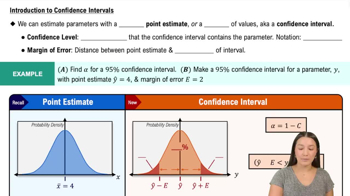
Introduction to Confidence Intervals

t-Distribution

The t-distribution is a probability distribution used when estimating population parameters when the sample size is small (typically n < 30) and the population standard deviation is unknown. It is similar to the normal distribution but has heavier tails, which accounts for the increased variability in smaller samples. The t-score is used in calculating the margin of error and confidence intervals.
Recommended video:
05:50
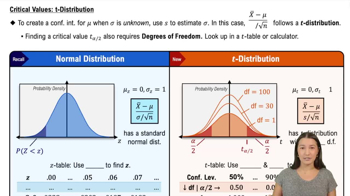
Critical Values: t-Distribution
Related Practice
Textbook Question

In Exercises 13–16, (a) find the margin of error for the values of c, s, and n, and (b) construct the confidence interval for using the t-distribution. Assume the population is normally distributed.

c = 0.98, s = 0.9, n = 12, xbar = 6.8

Textbook Question

[APPLET] The waking times (in minutes past 5:00 A.M.) of 40 people who start work at 8:00 A.M. are shown in the table at the left. Assume the population standard deviation is 45 minutes. Find (a) the point estimate of the population mean μ and (b) the margin of error for a 90% confidence interval.

Textbook Question

You wish to estimate, with 95% confidence, the population proportion of U.S. adults who have taken or planned to take a winter vacation in a recent year. Your estimate must be accurate within 5% of the population proportion.

a. No preliminary estimate is available. Find the minimum sample size needed.

Textbook Question

In Exercises 27–30, find the critical values and for the level of confidence c and sample size n.

c = 0.99, n = 10

Textbook Question

In Exercises 19–22, let p be the population proportion for the situation. (a) Find point estimates of p and q, (b) construct 90% and 95% confidence intervals for p, and (c) interpret the results of part (b) and compare the widths of the confidence intervals.

In a survey of 73,901 college graduates, 23,991 obtained a postgraduate degree. (Adapted from Gallup)

Textbook Question

In Exercise 19, would it be unusual for the population proportion to be 38%? Explain.