
Textbook Question
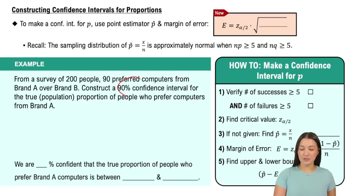
In a random sample of 36 top-rated roller coasters, the average height is 165 feet and the standard deviation is 67 feet. Construct a 90% confidence interval for μ. Interpret the results. (Source: POP World Media, LLC)

 Verified step by step guidance
 05:45
05:45
 05:11
05:11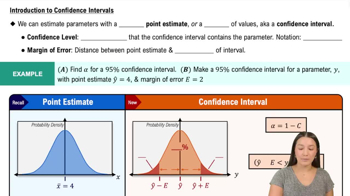 06:33
06:33In a random sample of 36 top-rated roller coasters, the average height is 165 feet and the standard deviation is 67 feet. Construct a 90% confidence interval for μ. Interpret the results. (Source: POP World Media, LLC)
Determine the minimum sample size required to be 99% confident that the sample mean driving distance to work is within 2 miles of the population mean driving distance to work. Use the population standard deviation from Exercise 2.
In Exercises 19–22, let p be the population proportion for the situation. (a) Find point estimates of p and q, (b) construct 90% and 95% confidence intervals for p, and (c) interpret the results of part (b) and compare the widths of the confidence intervals.
In a survey of 912 U.S. adults in Generation Z (born after 1996), 383 said they are at least somewhat likely to consider an electric vehicle for their next vehicle purchase. (Adapted from Pew Research Center)
In Exercises 27–30, find the critical values and for the level of confidence c and sample size n.
c = 0.99, n = 10
In Exercises 13–16, (a) find the margin of error for the values of c, s, and n, and (b) construct the confidence interval for using the t-distribution. Assume the population is normally distributed.
c = 0.90, s = 25.6, n = 16, xbar = 72.1
In Exercise 19, would it be unusual for the population proportion to be 38%? Explain.