Ch 44: Particle Physics and Cosmology
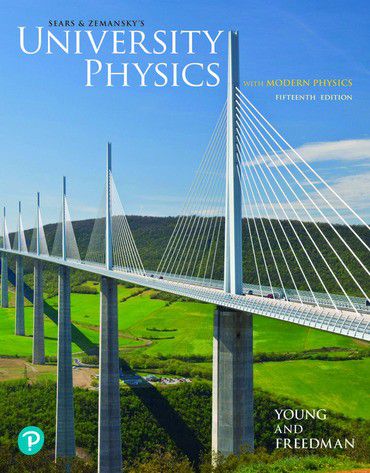
Young & Freedman Calc - University Physics 15th Edition
Young & Freedman Calc15th EditionUniversity PhysicsISBN: 9780135159552Not the one you use?Change textbook
Chapter 43, Problem 14

Calculate the minimum beam energy in a proton-proton collider to initiate the p+pp+p+η0p + p → p + p + η^0 reaction. The rest energy of the η0\(\eta\)^0 is 547.3547.3 MeV (see Table 44.344.3).

Verified step by step guidance
1
Step 1: Understand the problem. The goal is to calculate the minimum beam energy required for the proton-proton collision to produce the η^0 particle. This involves using the principles of energy conservation and relativistic kinematics.
Step 2: Identify the key quantities. The rest energy of the η^0 particle is given as 547.3 MeV. The rest energy of a proton is approximately 938.3 MeV. In the center-of-mass frame, the total energy must be sufficient to account for the rest energies of the two protons and the η^0 particle.
Step 3: Write the energy conservation equation. In the center-of-mass frame, the total energy before the collision is the sum of the kinetic energy and rest energy of the two protons. After the collision, the total energy is the sum of the rest energies of the two protons and the η^0 particle. The minimum energy occurs when the η^0 is produced at rest. The equation is: Etotal=2Eproton=2Erest+Eη
Step 4: Relate the beam energy to the center-of-mass energy. In a symmetric collider, the beam energy of each proton contributes equally to the center-of-mass energy. Therefore, the beam energy per proton is half of the total energy required in the center-of-mass frame. Use the equation: Ebeam=Etotal2
Step 5: Substitute the values into the equations. The rest energy of each proton is 938.3 MeV, and the rest energy of the η^0 particle is 547.3 MeV. Calculate the total energy required in the center-of-mass frame and then divide by 2 to find the minimum beam energy for each proton.

Verified video answer for a similar problem:

This video solution was recommended by our tutors as helpful for the problem above.
Video duration:
1m
Was this helpful?

Key Concepts

Here are the essential concepts you must grasp in order to answer the question correctly.

Conservation of Energy

In particle physics, the conservation of energy principle states that the total energy in a closed system remains constant. When calculating the minimum beam energy required for a reaction, one must account for the rest mass energies of the particles involved. The energy must be sufficient to create new particles, which means the initial kinetic energy of the colliding protons must equal the total rest mass energy of the final products.
Recommended video:
Guided course
06:24
Conservation Of Mechanical Energy

Threshold Energy

Threshold energy is the minimum energy required for a specific reaction to occur. In the context of particle collisions, it is the energy needed to produce the rest mass of the resulting particles. For the reaction p + p → p + p + η^0, the threshold energy can be calculated by summing the rest mass energies of the initial and final particles, ensuring that the kinetic energy of the colliding protons meets this requirement.
Recommended video:
Guided course
04:10
Intro to Energy & Types of Energy

Center of Mass Frame

The center of mass frame is a reference frame in which the total momentum of the system is zero. In collider experiments, calculations are often simplified by analyzing the reaction in this frame. The minimum energy required for a reaction can be more easily determined in the center of mass frame, as it allows for a direct comparison of the rest mass energies of the particles before and after the collision, facilitating the calculation of the necessary beam energy.
Recommended video:
Guided course
06:30
Intro to Center of Mass