Ch 44: Particle Physics and Cosmology
Young & Freedman Calc - University Physics 15th Edition
Young & Freedman Calc15th EditionUniversity PhysicsISBN: 9780135159552Not the one you use?Change textbook
Chapter 43, Problem 18

How much energy is released when a µµ^- muon at rest decays into an electron and two neutrinos? Neglect the small masses of the neutrinos.

Verified step by step guidance
1
Identify the particles involved in the decay: a muon (µ⁻) at rest decays into an electron (e⁻) and two neutrinos. Since the neutrinos have negligible mass, their rest mass energy can be ignored.
Recall that the energy released in the decay comes from the difference in rest mass energies between the initial particle and the final particles. The muon has a rest mass energy of \(m_\mu c^2\), and the electron has a rest mass energy of \(m_e c^2\).
Write the expression for the energy released (Q-value) as the difference between the initial and final rest mass energies: \(Q = (m_\mu - m_e) c^2\)
Look up or recall the rest masses of the muon and electron (in kilograms or atomic mass units) and the speed of light \(c\) (approximately \(3 \times 10^8\) m/s) to use in the calculation.
Substitute the values into the equation and calculate the energy released, remembering to keep the units consistent (e.g., joules or electronvolts).

Verified video answer for a similar problem:

This video solution was recommended by our tutors as helpful for the problem above.
Video duration:
1m
Was this helpful?

Key Concepts

Here are the essential concepts you must grasp in order to answer the question correctly.

Muon Decay and Particle Rest Mass

Muon decay is a weak interaction process where a muon at rest transforms into an electron and two neutrinos. The muon’s rest mass energy is converted into the kinetic energy of the decay products. Understanding the rest mass energies of the particles involved is essential to calculate the energy released.
Recommended video:
Guided course
04:32
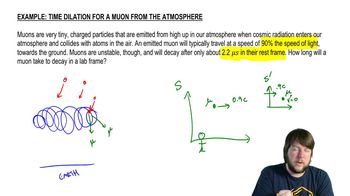
Time Dilation for a Muon from the Atmosphere

Conservation of Energy in Particle Decay

In particle decay, the total energy before and after the decay must be conserved. The initial rest mass energy of the muon equals the sum of the kinetic energies and rest mass energies of the decay products. Neglecting neutrino masses simplifies the calculation by focusing on the electron’s rest mass and kinetic energy.
Recommended video:
Guided course
06:24
Conservation Of Mechanical Energy

Mass-Energy Equivalence (E=mc²)

Mass-energy equivalence states that mass can be converted into energy and vice versa, as described by Einstein’s equation E=mc². The difference in rest mass between the initial muon and the final electron corresponds to the energy released during decay, primarily carried away as kinetic energy of the decay products.
Recommended video:
Guided course
4:52
Gravitational Potential Energy for Systems of Masses
Related Practice