Calculate the minimum beam energy in a proton-proton collider to initiate the reaction. The rest energy of the is MeV (see Table ).
Ch 44: Particle Physics and Cosmology
Young & Freedman Calc15th EditionUniversity PhysicsISBN: 9780135159552Not the one you use?Change textbook
Chapter 43, Problem 9a
Deuterons in a cyclotron travel in a circle with radius cm just before emerging from the dees. The frequency of the applied alternating voltage is MHz. Find the magnetic field.
Verified step by step guidance1
Step 1: Understand the relationship between the cyclotron frequency and the magnetic field. The cyclotron frequency is given by \( f = \frac{qB}{2\pi m} \), where \( f \) is the frequency, \( q \) is the charge of the particle, \( B \) is the magnetic field, and \( m \) is the mass of the particle. For a deuteron, \( q = 1.6 \times 10^{-19} \, \text{C} \) and \( m = 3.34 \times 10^{-27} \, \text{kg} \).
Step 2: Rearrange the formula to solve for the magnetic field \( B \). The equation becomes \( B = \frac{2\pi m f}{q} \). Substitute the given frequency \( f = 9.00 \, \text{MHz} = 9.00 \times 10^{6} \, \text{Hz} \) into the equation.
Step 3: Perform unit conversions if necessary. Ensure all values are in SI units before substituting them into the formula. For example, the radius \( r \) is given as 32.0 cm, which is \( 0.32 \, \text{m} \), but it is not directly needed for calculating \( B \) in this step.
Step 4: Substitute the values for \( m \), \( f \), and \( q \) into the formula \( B = \frac{2\pi m f}{q} \). This will give the magnetic field \( B \) in teslas (T).
Step 5: Verify the result conceptually. The magnetic field should be consistent with the frequency and the mass-to-charge ratio of the deuteron. If the calculated \( B \) is reasonable, it confirms the setup of the cyclotron is correct.

Verified video answer for a similar problem:
This video solution was recommended by our tutors as helpful for the problem above.
Video duration:
3mWas this helpful?
Key Concepts
Here are the essential concepts you must grasp in order to answer the question correctly.
Cyclotron Motion
Cyclotron motion refers to the circular motion of charged particles, such as deuterons, in a magnetic field. The radius of the circular path is determined by the particle's mass, charge, and the strength of the magnetic field. In a cyclotron, particles are accelerated by an alternating voltage, causing them to gain energy and increase their speed while maintaining a circular trajectory.
Recommended video:
Guided course
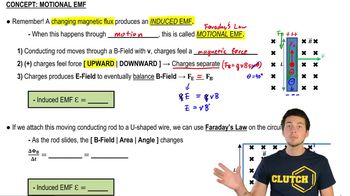
Motional EMF
Magnetic Field and Frequency Relationship
The relationship between the magnetic field strength (B) and the frequency (f) of a charged particle in a cyclotron is given by the equation f = (qB)/(2πm), where q is the charge, m is the mass, and B is the magnetic field. This equation shows that the frequency of the alternating voltage must match the cyclotron frequency for effective acceleration of the particles. Understanding this relationship is crucial for calculating the magnetic field strength.
Recommended video:
Guided course
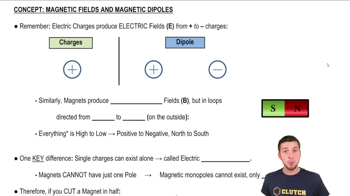
Magnetic Fields and Magnetic Dipoles
Radius of Circular Motion
The radius of the circular path of a charged particle in a magnetic field is influenced by its momentum and the magnetic field strength. The formula r = (mv)/(qB) relates the radius (r) to the mass (m), velocity (v), charge (q), and magnetic field (B). This concept is essential for determining the magnetic field strength when the radius and other parameters are known, as in the case of the deuterons in the cyclotron.
Recommended video:
Guided course
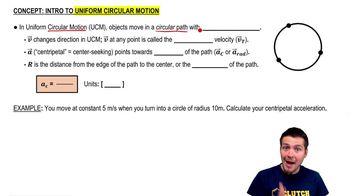
Intro to Circular Motion
Related Practice
Textbook Question
1
views
Textbook Question
A proton and an antiproton annihilate, producing two photons. Find the energy, frequency, and wavelength of each photon if the and collide head-on, each with an initial kinetic energy of MeV.
2
views
Textbook Question
A proton and an antiproton annihilate, producing two photons. Find the energy, frequency, and wavelength of each photon if the and are initially at rest.
2
views
Textbook Question
A high-energy beam of alpha particles collides with a stationary helium gas target. What must the total energy of a beam particle be if the available energy in the collision is GeV?
10
views
Textbook Question
What is the speed of a proton that has total energy GeV?
2
views
Textbook Question
An electron with a total energy of GeV collides with a stationary positron. What is the available energy?
2
views