Ch 44: Particle Physics and Cosmology
Young & Freedman Calc - University Physics 15th Edition
Young & Freedman Calc15th EditionUniversity PhysicsISBN: 9780135159552Not the one you use?Change textbook
Chapter 43, Problem 13a

What is the speed of a proton that has total energy 10001000 GeV?

Verified step by step guidance
1
Understand the problem: The total energy of the proton is given as 1000 GeV. The total energy (E) of a particle is related to its rest energy and kinetic energy. The relationship between total energy, rest energy, and momentum is given by the relativistic energy-momentum relation.
Write the relativistic energy-momentum relation: \( E^2 = (pc)^2 + (m_0c^2)^2 \), where \( E \) is the total energy, \( p \) is the momentum, \( c \) is the speed of light, and \( m_0 \) is the rest mass of the proton.
Rearrange the equation to solve for the momentum \( p \): \( p = \sqrt{\frac{E^2 - (m_0c^2)^2}{c^2}} \). Substitute the given total energy \( E = 1000 \text{ GeV} \) and the rest energy of the proton \( m_0c^2 = 0.938 \text{ GeV} \).
Relate the momentum \( p \) to the speed \( v \) of the proton using the relativistic momentum formula: \( p = \frac{m_0v}{\sqrt{1 - \frac{v^2}{c^2}}} \). Solve for \( v \) by substituting the value of \( p \) obtained in the previous step.
Simplify the expression for \( v \) and solve numerically if needed. The speed \( v \) will be very close to the speed of light \( c \), as the total energy is much larger than the rest energy.

Verified video answer for a similar problem:

This video solution was recommended by our tutors as helpful for the problem above.
Video duration:
4m
Was this helpful?

Key Concepts

Here are the essential concepts you must grasp in order to answer the question correctly.

Total Energy in Relativity

In the context of special relativity, the total energy of a particle is the sum of its rest mass energy and its kinetic energy. For a proton, this is given by the equation E = mc² + K.E., where E is the total energy, m is the rest mass, and c is the speed of light. Understanding this relationship is crucial for calculating the speed of a proton when its total energy is known.
Recommended video:
Guided course
05:29
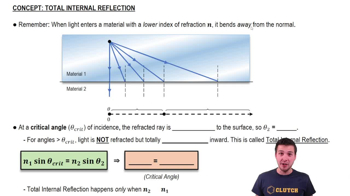
Total Internal Reflection

Relativistic Momentum

Relativistic momentum is defined as p = γmv, where γ (gamma) is the Lorentz factor, m is the rest mass, and v is the velocity of the particle. As the speed of a particle approaches the speed of light, its momentum increases significantly, which is essential for understanding how energy and speed relate in high-energy physics scenarios, such as with a proton at 1000 GeV.
Recommended video:
Guided course
05:17
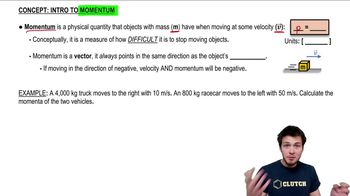
Intro to Momentum

Lorentz Factor

The Lorentz factor, denoted as γ, is a crucial component in relativity that accounts for time dilation and length contraction at high speeds. It is defined as γ = 1 / √(1 - v²/c²). This factor becomes significant when calculating the speed of particles moving close to the speed of light, as it affects both energy and momentum, making it essential for solving the given problem.
Recommended video:
Guided course
14:16
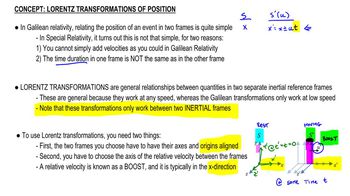
Lorentz Transformations of Position