
Ch 31: Alternating Current
Young & Freedman Calc - University Physics 15th Edition
Young & Freedman Calc15th EditionUniversity PhysicsISBN: 9780135159552Not the one you use?Change textbook
Chapter 31, Problem 18

A resistor with R = 300 Ω and an inductor are connected in series across an ac source that has voltage amplitude 500 V. The rate at which electrical energy is dissipated in the resistor is 286 W. What is (a) the impedance Z of the circuit; (b) the amplitude of the voltage across the inductor; (c) the power factor?

Verified step by step guidance
1
Step 1: Start by understanding the relationship between power, voltage, and resistance in an AC circuit. The power dissipated in the resistor can be calculated using the formula: \( P = \frac{V^2}{R} \), where \( P \) is the power, \( V \) is the voltage across the resistor, and \( R \) is the resistance.
Step 2: Given that the power dissipated in the resistor is 286 W and the resistance \( R \) is 300 Ω, use the formula \( P = \frac{V^2}{R} \) to find the voltage across the resistor. Rearrange the formula to solve for \( V \): \( V = \sqrt{P \times R} \).
Step 3: To find the impedance \( Z \) of the circuit, use the formula for the total voltage in an AC circuit: \( V_{total} = I \times Z \), where \( I \) is the current. First, find the current using \( I = \frac{V_{resistor}}{R} \), then use \( Z = \frac{V_{total}}{I} \) to find the impedance.
Step 4: To find the amplitude of the voltage across the inductor, use the relationship \( V_{inductor} = I \times X_L \), where \( X_L \) is the inductive reactance. Since \( Z = \sqrt{R^2 + X_L^2} \), you can solve for \( X_L \) using the impedance found in Step 3.
Step 5: The power factor is the ratio of the real power to the apparent power in the circuit. It can be calculated using \( \text{Power Factor} = \frac{R}{Z} \). Use the values of \( R \) and \( Z \) obtained in previous steps to find the power factor.

Verified video answer for a similar problem:

This video solution was recommended by our tutors as helpful for the problem above.
Video duration:
13m
Was this helpful?

Key Concepts

Here are the essential concepts you must grasp in order to answer the question correctly.

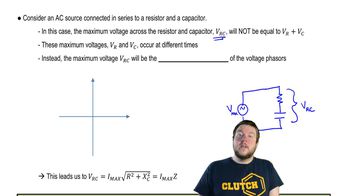
Impedance in AC Circuits

Impedance (Z) is the total opposition a circuit presents to the flow of alternating current (AC) and is a combination of resistance (R) and reactance (X). In a series R-L circuit, impedance is calculated using Z = √(R² + (ωL)²), where ω is the angular frequency and L is the inductance. Impedance affects both the current flow and the phase relationship between voltage and current.
Recommended video:
Guided course
08:40
Impedance in AC Circuits

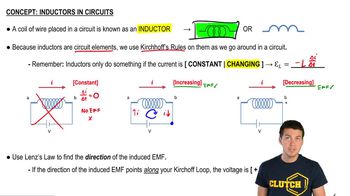
Voltage Across an Inductor

In an AC circuit, the voltage across an inductor is determined by the inductive reactance (X_L = ωL) and the current flowing through it. The voltage amplitude across the inductor can be found using V_L = I * X_L, where I is the current amplitude. This voltage is out of phase with the current by 90 degrees, leading the current in time.
Recommended video:
Guided course
07:10
Inductors in Circuits

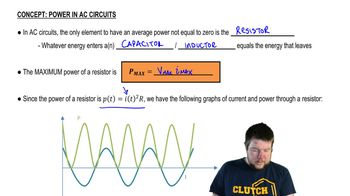
Power Factor in AC Circuits

The power factor in an AC circuit is the cosine of the phase angle (φ) between the voltage and current, given by cos(φ) = R/Z. It indicates how effectively the circuit converts electrical power into useful work. A power factor of 1 means all the power is used effectively, while a lower power factor indicates more power is wasted in the form of reactive power.
Recommended video:
Guided course
05:37
Power in AC Circuits